




I’m a writer and author with a passion for exploring ideas.
Since 2020, I’ve published monthly book reviews as a way to reflect on what I’ve read. I do my best to challenge my own thinking and remember the lessons worth keeping. Here you’ll find my books, my reviews, and my reflections on the ideas that have shaped my perspective along the way.
My Book
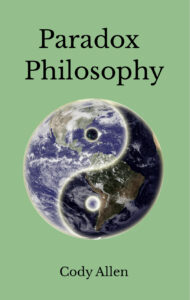 |
Paradox PhilosophyAll things are in both harmony and tension with their opposites—we often choose certainty despite our doubts, fear when there is opportunity for hope, and ourselves when we might think of others—and we should always strive to find greater balance between them. We all want to live meaningful lives, hopefully lives of moral goodness, and philosophy is the study of this venture. Paradox Philosophy is a modern, Westernized version of Yin Yang theory that delivers wisdom towards living a more virtuous life. Available at: |
Book Reviews
- Between Us: How Cultures Create Emotions by Batja Mesquita July 30, 2025
 Like many of us from Western cultures and societies, I have always assumed that most emotions are universal. Joy, sadness, anger, and fear are the big four that most psychologists agree on, and researchers in the 1970s and 80s (led by American psychologist Paul Ekman) conducted global studies on whether or not different cultures recognized the same facial emotions. Did a smile and a crinkle in the corner of the eye translate as ‘joyful’ or ‘happy’ to people in America, Asia, Africa, and even remote tribes in the Amazon? The answer they found was yes, and their research included similar findings for sadness, anger, fear, disgust, and surprise which led emotional researchers to conclude that there are ‘core’ emotions within each of us human beings regardless where we are from. They set the precedent and moved on. It is now years later, however, and this premise has been challenged. Our author’s new premise is that emotions differ from culture to culture and society to society and each must be understood in their own context. Nothing is universal, not even emotions.
Her biggest finding, one detailed throughout the pages of her book, is the difference between cultures that think of emotions from the inside-out and from the outside-in. In America (and Western Europe), for example, we think of emotions as things inside of us that we feel independently from everyone else. Alternatively, the Japanese (and other Eastern cultures), conceptualize emotions as things that occur between people first and then make their way into our behaviors and actions only after the situation has been assessed. The main supporting argument for this finding is simple: traditional Western cultures are individualistic whilst Eastern cultures are familial and collective. In the West, we think about ourselves first; in the East, they think about others first and foremost.
One of the ways Mesquita was able to research these differences in emotion was by observing mothers with young children. She encounters shame, for example, when she witnesses a Japanese mother purposely shame her child. To an American, it might have been seen as bad parenting, but for the Japanese, it is seen as helping the child understand how their actions affect the others around them. Mesquita records how “shame in WEIRD [Western, Educated, Industrial, Rich, Democratic] cultures is ‘wrong’ because it marks your own failure clearly visible to others,” and “shame in honor cultures [like Japanese and Chinese] is ‘right,’ even as it is deeply disturbing.” Shame is right in honor cultures because it tracks threats to the family’s social position and shows that the individual shares the central cultural concern of honor. Nobody wants to feel shame, but when we do, it means entirely different things depending on our culture.
Anger is another emotion that is experienced differently between cultures, albeit in this example both Americans and Japanese experience it similarly. “Anger is a claim for dominance,” she writes,” which is ‘right’ in cultures that emphasize entitlement and individual autonomy, ‘right’ in cultures where people compete for the scarce good of honor, but ‘wrong’ in cultures that empathize kindness for all living creatures or harmonious relationships.” The example she gives is Buddhists, who consider anger destructive to human nature. Buddhists believe that anger not only harms others, but also harms ourselves, because it chains us to worldly attachments and delusions that cause us to suffer. Because of this cultural belief, Buddhists do not think anger is an appropriate thing to feel inside nor an appropriate reaction to a present circumstance.
It all starts with how we learn to understand our emotions: They are taught to us by our parents and teachers and are also learned via trail and error as we live our lives. Everyone’s lives and experiences are different, and with this in mind, it seems reasonable to conclude that no community or individual will have exactly the same concepts about emotions as any other. There are no blanket answers to the question: What are you feeling? “The whole idea that ikari (Japanese), anger (English), and kwaadheid (Dutch) are ‘the same emotion’ originates from a MINE model: the idea that the real emotion is a mental state behind the story of anger.” But of course, this MINE model is how we Westerners make sense of emotions, not how the rest of the world does.
Some cultures have no equivalent translation for emotion words like ‘happy’ or ‘sad.’ Some cultures experience sadness as loss, some experience it as shame. Some cultures experience emotions as actions, like laughing or crying. Some cultures don’t have a word for the word ‘emotion’ at all. Just like how different cultures have different foods, music, and holidays, they also have different emotions. These emotions have evolved over time to become what they are today and they are as disparate and complex as the different cultures of the world are from one another.
In conclusion, it seems as though emotions often involve both an internal component and an external (relational) one as well. American’s also consider their anger in social contexts and the Japanese also experience how their shame makes them feel on the inside. While the main difference may be where it starts (from the inside-out, or the outside-in), it is valuable to recognize that both the personal and the relational are important to understand. This is especially true if we are traveling to a new place or interacting with someone from a different culture. It’s not just enough to ‘put ourselves in another’s shoes’ in order to understand how they are feeling, because we are still operating from our own experience. To truly understand the emotions of others, we must first try and understand their culture.
- The End of the World is Just the Beginning by Peter Zeihan July 9, 2025
 In the early days of human development, economics was regional: people could only trade goods and services within a reasonable proximity of where they lived. Populations and trade networks grew slowly over time as Empires (like the Roman’s) connected the ancient world via networks of roads. Inevitably, innovations in boating led sea-trade to expand the economic scope even farther as humanity progressed into the 17th, 18th, and 19th centuries and the world began to industrialize. As trade routes expanded across the globe, so did global interconnectedness, and “while the Industrial Revolution made it much cheaper to ship products from A to B, it took the Americans’ global Order to make transport much safer.” Since the close of the Second World War, the American military has transformed the seas from contested waters into safe, functional waterways. The premise of this book is what happens next: What happens when the Americans recede from their assumed role as the global shipping peace-keepers?
In short, everything will be affected, from transport to finance to energy to industrial materials to manufacturing to agriculture. Whereas the past eighty years have seen a remarkable number of countries industrialize, urbanize, and participate in globalization, Zeihan predicts that these trends will all reverse as globalization contracts. Deglobalization will lead to deurbanization which will in turn lead to deindustrialization. What will the world come to look like in the coming decades if this prediction proves to be true?
Things are going to look and feel different because they will in fact be drastically different from the world we have come to recognize today. For example, most oil and natural gas comes from three places on the planet: The Middle East, Russia, and North America. If shipping routes aren’t safe, what might happen when countries in Africa or Southeast Asia can no longer meet their energy import needs? In short, the lights will go out and the engines will stop. “If people cannot source globally traded energy products like natural gas or diesel, they will have a choice between not having heat for cooking or staying warm…or burning wood. The scale of the devastation—in terms of carbon emissions, land cover, biodiversity, smog, water quality, and safety—caused by half the world’s population reverting to wood burning is difficult to wrap the mind around.” It would certainly be a regression.
One of the scariest predictions in this book is Zeihan’s prediction for global agriculture. With safe global shipping routes, third-world countries have spent the past decades importing their food and growing their populations. What happens if they suddenly cannot import enough food? In short, famine. First world countries will also be affected, although probably not to the same extent. Without the ability to import the precious metals that go into manufacturing batteries and computer chips, we can say goodbye to electric vehicles and smartphones. The U.S. auto maker Ford, for example, taps “more than sixty countries and 1,300 direct suppliers that together have more than 4,400 manufacturing sites” just to build a car. We can all say goodbye to that, too.
A large piece of this global puzzle is also due to the aging populations of the industrialized world. The post World War Two generation is the largest generation of people the world has ever seen, a generation that is quickly reaching retirement age and requiring more state-sponsors services. This wouldn’t pose much of a threat if there were enough young people to replace them in the job market and continue generating taxable income. But there aren’t, and this is a trend that many countries around the world are experiencing including the United States, Japan, China, South Korea, Australia, Germany, France, England, and more. This places tremendous pressure on global finances as every major developing country has transitioned from a commodity-backed currency to a fiat one. To keep it simple, this basically means that central banks can print as much money as they need or want in order to pay for the government’s services to the people. This mass printing of money has led pretty much everyone into incredible debt, devaluing currencies across the board. This, also, does not bode well for the future.
So, what are Zeihan’s predictions for how things will shake out? “The defining characteristic of the new era is that we will no longer all be on the same side,” he writes and goes on to imagine a world broken up into factions. The Europeans will be on their own, as will the countries and islands of the southeastern pacific, as will Africa, the Middle East, and the Americas. Keeping this in mind, he speculates that America will probably be the best place in the world to be for a few reasons. Firstly, the US is the number one producer of oil and natural gas in the world, so our energy supply is safe. Secondly, we have good relationships with the Canadians and Mexicans, and are isolated from the rest of the world by massive oceans on each side. Thirdly, we still have a lot of space in the middle of the country for people, farms, and factories to occupy. The US will still experience hardship, but not nearly to the same extent as other countries with less advantageous geographies, less reliable currencies, and less stable political institutions.
The past eighty years of globalization have come to feel like normal, but the lesson illuminated in this book is that it is not. It has simply been a transitory period of time, much like all periods of time, and it is subject to change in drastic ways. The peace, prosperity, and “reasonable expectation of more” is what first changed the old economies of pre-global sea shipping routes. We have now reached another turning point (or breaking point) and if there is anything we can all expect from the future, it is not more; it is less.
- The Glass Castle by Jeannette Walls June 18, 2025
 Jeannette Walls was raised by parents who did not make economic security for the family a priority. Her father was an engineer and quick to share his intelligence with his children. He could fix most engines and knew the names of the stars and planets. He was also a hopeless alcoholic, spending his paycheck on booze and leaving everyone’s stomachs empty. Her mother was an artist and writer who never sold a painting or a book. She made no money except when Walls and her siblings pleaded with her to be a teacher—a job she could never hold down because she didn’t like showing up. Her parents were irresponsible, and throughout her entire childhood, Jeannette and her siblings never knew stability.
When they lived in California, they camped in the desert and worried for water. When they lived in Arizona, they lived in a house filled with cockroaches that had no locks on the doors. When they lived in West Virginia, winter froze the water, rainstorms poured through holes in the roof, and a mudslide carried the front steps away. There were many instances when, without warning, their father would disappear for a few days, or their mother would refuse to get out of bed, or they wouldn’t have anything to eat.
What is captivating is that despite her poor circumstances, Walls developed and maintained a strong internal sense of responsibility (so did her three siblings). If her parents weren’t going to take care of her, then she was going to have to take care of herself, and she started learning early. She taught herself how to cook and do household chores, she made her own braces, she fought off a bigger kid who wanted to rape her, and she learned how to manage the little money that they did have. She developed a spirit of resourcefulness throughout the book that led to her paying her way through college with scholarships and part-time jobs and eventually becoming a published author.
The book is well written. It moves at a great pace and kept my attention from cover to cover. I enjoyed her voice as narrator and enjoyed getting to know each member of her family intimately through her eyes. It was beautiful to see her question her circumstances and slowly come to recognize that she both loved her parents for their kindness and intelligence and hated them for their abuse and neglect. Her stories have the full range of human emotion infused into them and are equal parts heartfelt and entertaining.
At the end of the book, the kids are all adults and living in New York City. Their parents are living in the city too and are voluntarily homeless. Walls and each of her siblings relates to their parents in different ways, much reflective of each of our own complicated family dynamics. If this book had a message it would be: You can’t choose your family, but you can choose how much responsibility you take for yourself.
- When Breath Becomes Air by Paul Kalanithi June 4, 2025
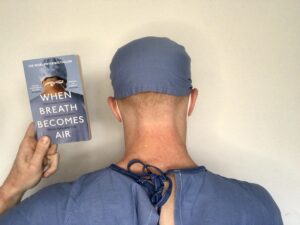 At the age of 36, Paul Kalanithi was diagnosed with stage IV lung cancer. He was at the tail end of over a decade of study as a doctor specializing in neurosurgery and just as his career was about to begin, and undoubtedly soar to great heights, he was sidelined with an impossibly grim illness that led to his untimely death only a short 22 months later. During that time, he wrote this book, a reflection on his life, on medicine, and most importantly, on mortality.
Part one is pre-diagnosis and all about his life growing up as a child of Indian immigrants to the United States. His father was a cardiologist and his mother a physiologist and they both exposed Kalanithi and his brothers to science and the medical fields when they were young. In addition to this, his mother insisted on exposing her children to classical literature and Kalanithi details how he grew up reading authors like T.S. Eliot, Fyodor Dostoevsky, Albert Camus, and Virginia Woolf. He developed a love of literature and a keen interest in philosophy as a young man, especially the topic of life and death, and went in search of answers in many places. He eventually pursued majors in both English literature and human biology, reflecting his interest in the human brain from both an intellectual and a physical perspective.
Part two of the book details his heartbreaking cancer diagnosis and his determination to continue to live his life to the fullest despite his bleak future. “Even if I’m dying, until I actually die, I am still living,” he writes. He was in his final year of residency when he was diagnosed and despite trying to finish, his body could not endure the long hours required, and he ultimately had to give up on his dream of neurosurgery. He was forced to say goodbye to his identity as a doctor and instead pick up a pen and embrace a new identity as a writer. He wrote tenaciously and desperately, trying to finish his memoir before his cancer finished him.
His writing is soft and powerful and reading his book was like listening to the voice of a trained physician, someone who had practiced having hard conversations with families in distress. “The physician’s duty is not to stave off death or return patients to their old lives,” he writes, “but to take into our arms a patient and family whose lives have disintegrated and work until they can stand back up and face—and make sense of—their own experience.” In a cruel twist of fate, he had to take his own advice as his role changed from doctor to patient, and it was fascinating to travel through this terrible transition with him.
This book is equal parts uplifting and heartbreaking. It’s filled with the same questions we all ask ourselves: Are we happy? Are we really living the life we want? What would we do if we only had a limited time on this planet? Sadly, Kalanithi was faced with this reality sooner than the rest of us, and yet he answers these questions by continually choosing life. Personally, I found his optimism remarkable. He continued to believe in his future even when all the signs were indicating that he shouldn’t. Despite his diagnosis, he and his wife decided to have a child—perhaps foolishly, perhaps bravely—because they weren’t going to let life dictate to them how they were going to live. Holding his daughter in his arms is one of the highlights of his short life, and this book is a treasure that she will be able to cherish for the rest of hers.
While Kalanithi was given a shorter timeline than the rest of us, we all must determine what is truly important in our lives, and this book is a push in that direction for whomever reads it.
- Nexus by Yuval Noah Harari May 12, 2025
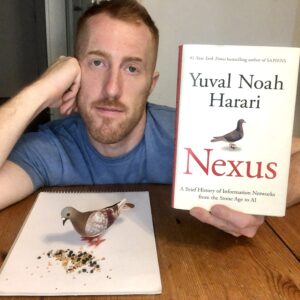 Many of us believe that information is the road to truth: the more of it we have, the faster we can travel to our destination. Harari dispels us of this idea, writing with great detail and providing many examples of his notion that information is meant to connect us. Truth seeking, he writes, is associated with our ability to self-correct.
In order to govern and regulate a giant number of people, governments must strike the correct balance between truth and order. They typically do this via mythology and bureaucracy, which are “the twin pillars of every large-scale society.” Mythology, because humans must believe in their shared story as citizens of a place (intersubjectivity), and bureaucracy, because the government must know who it’s people are, what they own, and other various information about them so as to aid them in life endeavors. Tax records, property rights, and police files, for example, can be extremely efficient in helping states maintain their power (for better or worse).
The invention of writing was the first way that humans evolved a method for storing and sharing information and it’s implementation went hand in hand with the growth of societies as information could be recorded and revisited at a later date. Whereas we once determined who owned which farm via discussions with our neighbors and friends, writing transferred this information to a central location, stored for the long-term use of whoever was the king in charge of the land. As more and more records were organized and kept for increasing numbers of people, more and more people were tasked with this record keeping, and bureaucracies were formed. This allowed societies to grow in size as greater order was kept, but it also allowed some truthfulness to slip through the cracks: it didn’t matter if everyone in town believed that your farm belonged to you because if someone produced a document that claimed ownership, and the king believed it, it was rightfully his.
As information networks advanced, the balance between truth and order became more and more difficult for governments to achieve. When the printing press was first invented and writing was able to be widely distributed, was humanity entered into an era of greater truthfulness? No; greater truthfulness evolved in tandem with greater falsity. Good ideas were able to be shared faster and farther than ever before, like the concept of personal liberty, but so were bad ideas, like the idea that witches were responsible for societal maladies. It took humanity many years to dispel with the idea of witches, and it wasn’t thanks to our newfound ability to disseminate writing and information: it was due to our collective ability to self-correct. The invention of the printing press gave us books, like the Bible, and millions of people connected under the umbrella of organized religion. Organized religions are great at creating order, but are their doctrines truthful?
When the radio was invented, it made greater amounts of information available to greater numbers of people, and, just like what happened with the advent of the printing press, humanity did not become flushed with more truth, we became flushed with both good ideas and bad ideas. The radio gave both Hitler and Roosevelt the ability to rally their citizens for distinct purposes: totalitarianism and democracy. What do these and other information networks (like the internet, for the most recent example, and the dawning of artificial intelligence) have in common? The ability to connect us in greater and faster ways. The common denominator of new information networks like the printing press and the radio is greater connection, not truth.
This book is inherently a political book as it has to do with how information networks are managed and controlled by governments. Harari makes a clear distinction between types of governments, describing how “democracy and autocracy aren’t absolutes; they are part of a continuum.” The difference between the two is how they balance truth and order, because “just as modern technology enabled large-scale democracy, it also made large-scale totalitarianism possible.” The Soviet Union, for example, maintained a high level of order as all information was centralized and processed in Moscow. As a result, it sacrificed truth. Democracies, on the other hand, are decentralized and predicated on the free sharing of ideas, and while they allow more truth in their governing systems, they maintain less order amongst the populace. We are currently seeing this with the internet’s ability to disseminate more truth to people: government’s are losing their grip and order is turning into chaos.
With this observation in mind, Harari moves on to tackle the most important question of our time: Artificial Intelligence. Whereas bureaucracies were once organized and maintained by humans and eventually computers, never before has one been organized and maintained by a super-intelligent computer. Not only is AI a new and powerful information network, it is also the first one ever created that can come up with new ideas without human input and then autonomously implement them. What does this mean for our search for truth? What happens if an AI supercomputer becomes so adept at its bureaucratic bookkeeping that we humans can no longer understand how it comes to its conclusions about whether or not to approve a loan application or the purchase of a plane ticket?
In order to maintain order as societies grew, humans created intersubjective stories (mythologies) in order to connect ourselves in greater numbers. What might happen if a group of artificial intelligences create their own inter-computer mythologies that we don’t approve of or don’t even know about? What might these AI systems decide to do with this power? “The immediate results of the print revolution included witch hunts and religious wars alongside scientific discoveries, while newspapers and radio were exploited by totalitarian regimes as well as democracies. As for the Industrial Revolution, adapting to it involved catastrophic experiments such as imperialism and Nazism. If the AI revolution leads us to similar kinds of experiments, can we really be certain we will muddle through again?”
The most important thing that we humans must fight to maintain control of is our ability to self-correct. This is, in essence, the scientific method: the ability to test a theory, get some answers, test a new theory, get some new answers, and ultimately change our beliefs. Determining the truth is a process that is often muddled by the means of information networks, and AI will surely make these waters murkier as it continues to do more and more of our thinking for us.