




I’m a writer and author with a passion for exploring ideas.
Since 2020, I’ve published monthly book reviews as a way to reflect on what I’ve read. I do my best to challenge my own thinking and remember the lessons worth keeping. Here you’ll find my books, my reviews, and my reflections on the ideas that have shaped my perspective along the way.
My Book
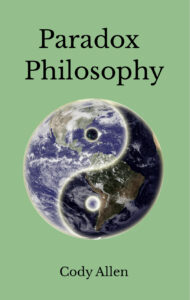 |
Paradox PhilosophyAll things are in both harmony and tension with their opposites—we often choose certainty despite our doubts, fear when there is opportunity for hope, and ourselves when we might think of others—and we should always strive to find greater balance between them. We all want to live meaningful lives, hopefully lives of moral goodness, and philosophy is the study of this venture. Paradox Philosophy is a modern, Westernized version of Yin Yang theory that delivers wisdom towards living a more virtuous life. Available at: |
Book Reviews
- Let’s Pretend This Never Happened by Jenny Lawson November 11, 2025
 Jenny Lawson’s book is comedy first, memoir second; the trains of thought free wheeling and hilarious. She loves a good rant and likes to protest against her “editor’s” suggestions. She has false chapters and enjoys intentionally blending the line between fact and fiction. She has fun with her writing and she does so in laugh out loud fashion.
It tells of her life growing up in rural Texas and all of her animal encounters. Her father was a taxidermist and was always stopping his truck to pick up dead raccoons off the side of the road. They had many alive animals as well—waking up to her father bringing a bobcat into the bedroom wasn’t uncommon. There were dogs and cats and chickens and goats and foxes and squirrels and bats and snakes and many more. Her mother was a bookkeeper and was a stern and stable figure who reacted to all of her husband’s ridiculous antics as if they were totally normal.
Lawson marries a man named Victor when she’s 24 and has a daughter and a family of her own. They move to Houston, and she thinks she’s escaped from the craziness of rural Texas. However, after a few years pass by, a part of her begins to miss it. Her sister, who also had a wild childhood, seems to miss it as well. There aren’t as many animals in the city and they feel cut off from their parents and their upbringing. Eventually they move back and recreate their eccentric childhood for their own children, this time with Grandpa and Grandma in the mix,
Beneath the comedic surface Lawson struggles with mental illness and she’s open about it in her stories. She reflects on how her childhood depression led to eating disorders and bulimia and how her adult anxiety makes her word vomit horrible stories at parties. Thankfully, she has developed a sense of humor, however dark, as her coping mechanism and her shield. She channels it into her writing well (both in her books and on her blog).
She writes about connection and loneliness and family dynamics in a way that we can all relate toH and her stories are charming and off the wall and embrace their weirdness. The book is both an exploration and a reflection of how absurd life can be. It should be served with a coke.
- Angela’s Ashes by Frank McCourt October 28, 2025
 Ireland in the 1930s and 1940s was a poor place. Their hate for the English had been simmering after centuries of oppression as the English extracted all the food and wealth from the smaller Irish nation and left the locals with nothing. Despite this reality, many Irishmen went to England for work and better wages. Frank McCourt’s father went, and instead of sending the money home to his wife and four kids, he spent it on the drink.
With an absent father, his mother begged in the streets. She asked the local church for whatever they could spare and often came home empty handed. Without coal for the fire, the family spent many nights cold and hungry. She had seven children, four of whom survived to adulthood; the twins died at two and the lone baby girl didn’t make it six months. Her own mother hated her for marrying a man from North Ireland and having his children and never let her forget it. Her sister was bitter and selfish.
Throughout his childhood, Frank McCourt was hungry all the time and his physical growth was stunted from malnutrition. Breadcrumbs were priceless. Many of his teeth were rotting and falling out of his mouth, he barely survived typhoid fever, and he lived many years of his life with an eye infection that gave him blurry vision. He had one set of clothes; the ones he was wearing. He slept under newspaper and used the walls of his house for firewood. He shared a bed with his family and also a family of fleas. He was beaten at school by his teachers for insubordination.
Frank also loved to go to the cinema on the weekends and he gorged on toffees when he had an extra penny. He was proud to take care of his younger brothers when his mother and father could not. He loved to read, and had excellent hand writing—known as having a “fine fist.” Despite his bleak circumstances, he found opportunities to play.
His writing is innocent, just like a young boy would be growing up in a confusing world, and as he relates his story, he comes across as a very curious youngster. However, asking questions of his elders was frowned upon, and he was often left to wonder about the mysteries of life. Mysteries like: why is my dad an alcoholic while others aren’t? is it a sin to steal food if I’m starving? and why did the twins die when they were only two years old?
The book is captivating, heart-wrenching, and funny. It’s a great reminder that no matter how bad you think your life is, someone else’s life is harder, and even Frank McCourt’s story echo’s this sentiment: there were many families worse off than his. McCourt was lucky enough to have shoes while some kids went barefoot every day, even in the winter. He also had enough food to survive to adulthood. Other kids did not.
Reading this book made me laugh, cry, and ultimately feel grateful for the things that I have.
- The Obstacle is the Way by Ryan Holiday September 26, 2025
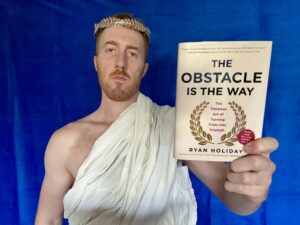 Everybody’s got problems. We all wish they would go away or be solved, but that isn’t how life works, no matter how many times we tell ourselves “if I could just solve this problem, or just get past this difficulty, then I can get on with my life.” Inevitably, as soon as we solve our current problem, life presents another. The solution, then, is not to view problems as obstacles, bur rather to change our frame of mind and view them as possibilities for growth. Changing the way we think about the obstacles we encounter in life is the theme of this book. It starts with stoicism.
Stoicism has been a known philosophy for thousands of years. First taught by Zeno of Citium in Athens around 300 BC, it has ebbed and waned in popularity over the centuries. During the height of the Roman Empire, it was championed by Seneca, Epictetus, and the Emperor himself, Marcus Aurelius. It was lost for a while, as religion swept throughout the Eurasian continent, but was revived again during the Renaissance when Justus Lipsius and Michel de Montaigne brought stoic ideals to the public through their writing. Today, Ryan Holiday has brought stoicism’s tenets to our society in his own words, and this book is some of his best work.
The essence of stoicism is the idea that while we are not in control of the events of life, we are in control of how we respond to them. We cannot control whether or not it will rain today, but we can control what we may do in response to the rain and how it might make us feel. This is the same as any problem, setback, or obstacle we encounter: we can by stymied by our misfortunes or we can learn from them and use them to grow.
In 1914, a massive fire erupted in Thomas Edison’s factory and burned up years of his work in a matter of hours. Instead of despairing, Edison said “Thank goodness all of our mistakes were burned up, now we can start fresh!” He used the disaster as an opportunity to reset, refocus, and rebuild. We too can follow this example; Let’s say we lose our job. While this might initially feel like a huge obstacle because we are losing our source of income, we might change our thinking and recognize it as an opportunity to find a new job that pays more or that we like better. Losing our job might have been unavoidable, but determining what we do as a result, the story we tell ourselves about why, and ultimately how we feel about it is up to us. This leads me to one of my favorite parables: The story of the Chinese farmer.
Once upon a time, in a village in China, there was a wise old farmer. One day, his horse ran away, and all the neighbors came to his house to offer their condolences saying “Oh no, how terrible, your horse has ran away!” The farmer simply replied “Maybe, we’ll see.” The next day, the horse returned, bringing with it three wild horses, and the neighbors came back and said “Wow, how wonderful, you have three new horses!” Again, the farmer simply replied “Maybe, we’ll see.” The next day, the farmer’s son was trying to tame one of the wild horses and was thrown off and broke his leg. The neighbors came with their condolences saying “How awful, how sad that your son has broken his leg,” to which the farmer again replied “Maybe, we’ll see.” A week later the army came to the village conscripting young men for war, but because of his broken leg, the farmer’s son was not taken. The neighbors celebrated, exclaiming “How lucky you are that your son does not have to go to war!” Once again, the farmer only replied by saying “Maybe, we’ll see.” The moral of the story is that we never know what is going to happen next in life, so celebrating or lamenting a recent event is all but futile. What we can control is how we respond to the various events of life and what stories we tell ourselves about their meaning.
What makes this book a success is Holiday’s ability to translate his concepts into bite size pieces of actionable advice. It’s not just theoretical, but practical. Holiday breaks it down into three parts: Perception, Action, and Will.
In the first part, on perception, Holiday asks us to be objective about how we perceive the world. He encourages us to let go of our ego and our desire to see things as we wish they were and embrace the realities of what is. He urges us to control our emotions and judgments, lest they get the better of us. In the second part, on action, Holiday asks us to take deliberate, bold, and persistent action. He suggests, once again, that we focus on what we can control, and not expend energy worrying about things that are beyond our capabilities. In the third part, on will, Holiday suggests that we prepare ourselves for adversity, loss, pain, and the potential for none of our efforts to produce our desired results. He inspires us to cultivate resilience and inner fortitude, for even if our efforts at solving a problem are successful, there is inevitably another one coming soon, most likely before we are ready for it.
I have read this book several times throughout my life and I like to keep it close at hand for whenever I need a little philosophical inspiration. The chapters are bite-sized, each taking a couple of minutes to read, and are great for reflecting on and considering how each idea may or may not resonate in our own life. It’s jam packed with stories about such figures as Ulysses Grant, Thomas Edison, Margaret Thatcher, Amelia Earhart, Samuel Zemmurray, Erwin Rommel, Richard Wright, Laura Ingalls Wilder, Barack Obama, Nassim Taleb, and many, many more. Holiday writes in such a way that we, the reader, feel equal to these great men and women in our endeavors, for we are all just human beings solving problems to the best of our ability. It is well written, inspirational, actionable, and for everybody. If you read this book, you too are a philosopher.
- Four Thousand Weeks by Oliver Burkeman August 28, 2025
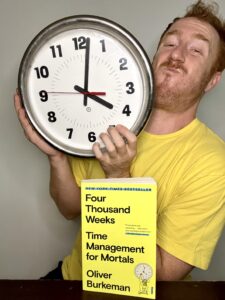 The average human lifespan is about four thousand weeks. That’s all we get, if we’re lucky. So, what do we do with such a limited amount of time here on Earth? In an era defined by productivity, the answer to this question has never been more important.
Is life short or is life long? My ex-girlfriend and I always used to debate this question; she said short, I said long, but we both agreed that the answer depended on what we were comparing it to. If I’m comparing my lifespan to a fruit fly, it’s long, but if I’m comparing it to the age of the earth, it’s desperately short. Of course, the purpose of the debate wasn’t to determine who was correct because the answer is subjective, the purpose was to have a philosophical discussion about how to best spend our time.
She believed life was short, and placed on emphasis on living in the moment and bringing as much joy as she could to the people around her each and every day. I, on the other hand, think often about how the future of my life might play out and am constantly weighing how the decisions I make today will impact my life later on. When she wakes up in the morning, she thinks about what the day has in store for her. When I wake up, I think about what I can do to alter my tomorrow. I can’t speak for her inner voice, but mine often tells me I’m lagging behind my contemporaries and the obvious solution is to work longer and harder towards my goals.
What Burkeman touches on in his book is a message I need to hear: No matter how much I manage to get done, there will always be more to do. Efficiency is a trap! The tips and tricks for becoming a more productive person (organizing to-do lists, optimizing a morning routine, prepping and cooking meals for the whole week on Sunday night, etc.) will never leave us with more time because the faster and more efficient we become, the more life will send us things that demand on our time. “Facebook, for example, is an extremely efficient way to stay informed about events you might like to attend. But it’s also a guaranteed way to hear about more events you’d like to attend than anyone possibly could attend,” Burkeman writes. We tell ourselves that if we could just reply to the rest of our emails and empty out our inbox we will have time to attend to the things we really want to do, but the truth is “if it weren’t for email, we wouldn’t be receiving all those messages in the first place. The technologies we use to try to ‘get on top of everything’ always fail us, in the end, because they increase the size of the ‘everything’ of which we’re trying to get on top.”
One of Burkeman’s solutions, then, is to reevaluate our relationship with time. Time is not a resource that we can ‘use’ or ‘spend,’ he argues, and takes a page out of the German philosopher Martin Heidegger’s book when he suggests time is not something we have at all, but instead is something we are. The reason we cannot ‘spend’ our time on one thing or another is because we are always spending it every minute of every day no matter what. Whether we choose to go for a walk or to sit on the porch and watch the sky, time is passing. After all, when someone asks our age we don’t respond by saying “I’ve used 35 years so far,” we say “I am 35-years-old.”
Another solution our author offers to optimize our attention is to determine what things we are not going to do. This, in a way, is really what focusing is all about. It is the stripping away of any and all extraneous stimulus and giving our attention to the few select areas that we deem most important. We must ask ourselves, is it really that valuable to answer every single email if it means we might not get to the project we promised ourselves we would do? What if we leave the emails and instead focus on the things we deem most important?
If Burkeman had been present with my ex and I when we used to debate the length of life, he would have taken her side and implored me to view it as short. We’ll never finish our to-do lists, he would have said, and we should accept our finitude. “At the end of your life, looking back, whatever compelled your attention from moment to moment is simply what your life will have been,” he writes, “so when you pay attention to something you don’t especially value, it’s not an exaggeration to say that you’re paying with your life.” The lesson is simple: instead of trying to be productive in every area of our lives, we should carefully pick and choose the things we give our attention to. After all, we’re only here for four thousand weeks.
- The Wisdom of Anxiety by Sheryl Paul August 7, 2025
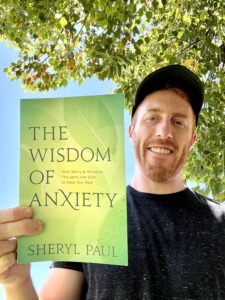 We all have anxiety. We worry that our spouse has eyes for someone else, that our kids aren’t growing up in the same world that we did, or where the money will come from if we finally decide to quit our job. We worry about family, friends, money, jobs, and what in the world tomorrow may bring. All of these are important things to think about and our lives would be worse if we didn’t, but they need not emotionally control us, cripple us, and keep us up at night. “Anxiety is the soul’s way of communicating that something inside is awry, out of balance, or needs attention,” Paul writes, “it’s a messenger pointing to a need or wound that needs attention inside.”
Anxiety is a doorway to self-awareness, and when we suppress it, or take a doctor’s prescribed medication to mute the feelings, we cut ourselves off from receiving the messages it’s trying to convey. Anxiety is our body and soul communicating to us and it’s our job to explore our feelings in order to further understand. The appropriate response is not avoidance but curiosity and compassion, because the more we respond with curiosity and compassion, the more we are able to understand and heal. When it comes to understanding our anxiety and working with it to heal ourselves, Paul suggests we break it down into four different realms of self: physical, mental, emotional, and spiritual.
Physically, we feel anxiety when our muscles are tight and our breathing is shallow. The antidote here is simple exercise, which is both “prophylactic and prescriptive: when we exercise regularly, we create a less inviting environment in our physical body for anxiety to take hold; and when anxiety is stirring, exercise reduces its intensity.” We should also be aware of how much we’ve had to eat and drink, as sometimes a throbbing headache is a symptom of low blood sugar or dehydration, not the existential death we imagine it to be.
Mentally, we may listen to intrusive negative thoughts and get stuck in a worry loop. Whether or not our partner is ‘the one’ is a thought that can keep us up at night as we play out endless scenarios in our heads about what the future with this person might hold. If we examine our thoughts closer, however, we may realize that these thoughts are our anxiety trying to communicate with us that what we are truly scared of is commitment or vulnerability and has nothing to do with our partner. This is similar to the emotional realm, where buried emotions can come to the surface as anxiety, like for example when we move to a new place and find ourselves angry at our new surroundings when in reality we’re lonely and sad that we’ve left our old friends and neighbors behind.
Our spiritual anxiety is often existential and usually arises during major life transitions. When we have a birthday we may find ourselves wondering ‘Am I on the right path in life?’, or after we achieve a big life goal we may ask ourselves ‘What is my purpose now?’ These questions are getting at something deeper—questions of purpose, mortality, uncertainty, and the meaning of our lives. These are important questions to contemplate, but they need not consume us. It’s our job to consider them with curiosity and compassion as opposed to fear and distress.
The strategies Paul promotes for understanding and working with our anxiety are simple, albeit not easy. The first and mort important is not to hide from our anxiety or shame it, but to recognize that it is trying to tell us something deeper. It is an alarm bell and we must answer the call, not cover our ears to the sound. Physically, we can journal, meditate, practice an artistic hobby, or spend time in nature. Mentally and emotionally we can practice allowing our uncomfortable feelings to be felt and to pass through us, for things bottled up will eventually explode. Spiritually, we can access what Buddhists call refuge, which is “the quiet resting place inside where you can hear the noise of your mind settle down and physically feel your soul relax. It’s your own private retreat that’s accessible and free.” This is what Paul calls our “well of being,” which makes sense, because anxiety is helping us examine our well-being.
Ultimately, it all starts and ends with self-compassion because our anxiety is a part of us. If we ignore it or tamp it down, we remain ignorant to its messages. If we open ourselves up to exploring anxiety’s deeper meanings, we not only come to a greater understanding of ourselves, but we grow stronger. We must lean in and accept, not back away and hide.