




I’m a writer and author with a passion for exploring ideas.
Since 2020, I’ve published monthly book reviews as a way to reflect on what I’ve read. I do my best to challenge my own thinking and remember the lessons worth keeping. Here you’ll find my books, my reviews, and my reflections on the ideas that have shaped my perspective along the way.
My Book
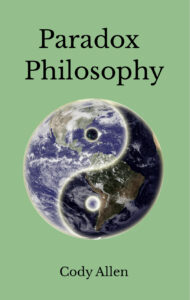 |
Paradox PhilosophyAll things are in both harmony and tension with their opposites—we often choose certainty despite our doubts, fear when there is opportunity for hope, and ourselves when we might think of others—and we should always strive to find greater balance between them. We all want to live meaningful lives, hopefully lives of moral goodness, and philosophy is the study of this venture. Paradox Philosophy is a modern, Westernized version of Yin Yang theory that delivers wisdom towards living a more virtuous life. Available at: |
Book Reviews
- good morning, monster by Catherine Gildiner November 30, 2022
 **Please be warned, this review is about the trauma of victims of abuse and includes graphic imagery**
There are people who train their bodies and minds for years, go to fight in a foreign war, get injured in the line of duty, and return home to accolades and praise for their service. They are heroes. There are also people who get raped from the age of three until the age of fourteen by their father, have their grandmother starve them and beat them for complaining of hunger, and manage to grow up and graduate from a good school, keep a steady job, and fall in love. These people are also heroes, albeit a different kind.
Catherine Gildiner was a clinical psychologist and practicing therapist for 25 years and this book is a distillation of 5 of her most traumatic cases. Her clients were victims of every kind of abuse you can imagine, from physical to emotional to sexual. Many were victims of all three, in addition to abandonment, neglect, and, in one case, true sadism (one patient’s father was a member of a Ted Bundy fan club).
Imagine you’re ten years old, and every morning when you wake up your mother greets you by saying “Good morning, monster.” She doesn’t do it in a playful way; she genuinely means it. You ruined her life. Or, imagine being abandoned by your father at the age of 9, in a cabin in rural Canada in the dead of winter, left to care for your 7 year old sister and 6 year old brother. This harrowing tale also happened to one of her patients, who somehow managed to not only survive, but went on to get married, have children of her own, and love them.
Her patients were able to overcome their traumatic childhoods with her help and guidance, and she is gracious enough to share some of her techniques in the pages of her book (with names and locations changed for the privacy of her clients). A very important tool is reframing, which is “taking a concept and relabelling it so as to alter its meaning.” For example, when her patient described not being able to properly raise her 6 and 7 year old siblings in the Canadian winter as a failure, Gildiner reframed that as a success, because all three children survived and lived to adulthood.
Some therapy takes a few weeks or months, depending on the severity of the symptoms and the problems the patient is seeking help with. These particular cases spanned years, as her patients needed to build trust with someone who genuinely cared about their wellbeing. “Therapy is a lot like growing a tree,” she writes. “For the first few years there appears to be no major growth, but by the third year, after the roots have established themselves and can support the trunk, the tree shoots upwards.” They needed repeated exposure to her emotional support for them before they could take positive steps towards recovery.
One of the most important revelations from her work is that therapy isn’t about finding the truth. It’s really about getting your unconscious mind to stop controlling your conscious one. “Effective therapy is about lowering your defenses so that you can deal with the issues that arise in your life.” If you never developed secure attachment to your mother as an infant (one of her patients was locked in the attic from 6am to midnight from ages 2 to 5), you may be emotionally stuck there. The conscious mind lives on as you grow older, but your unconscious is still stuck in that attic, crying out for the love and attachment that parents are supposed to provide in early infancy. Only with a nurturing, safe environment can the patient allow themselves to understand this and work to build healthy attachments and eventually love.
Most of her patients did not believe they were deserving of love. If your parents, the people who are supposed to love you unconditionally, actively do not, how are you supposed to learn what love really is and how to do it? The sad reality is that “almost all abusive parenting is based on generations of the same; those who are abusive were likely themselves abused.” There are no villains in these cases, as patients often times feel sympathy for their parents who never had a chance to hone the proper parenting tools. Sadly, families can pass dysfunction and trauma down through generations the same as genetic traits.
While she undoubtedly had some patients who didn’t find success in therapy, the 5 mentioned in her book all made substantial steps towards leading happy and healthy lives. The lesson to take away is that no matter who you are or what your childhood was like, you can overcome it. “Love,” she taught them, “means vulnerability; people who love you can also hurt you. Making oneself vulnerable is the ultimate in bravery.” I also believe this to be true: Love requires vulnerability, and vulnerability requires bravery. You might not feel much love in your life right now, but you can learn to open yourself up to it in ways that are safe. Regardless of how you grew up, we are all deserving of love. Don’t you dare think otherwise. (And if you do, find a therapist. They literally save lives.)
- Never Split The Difference by Chris Voss November 16, 2022
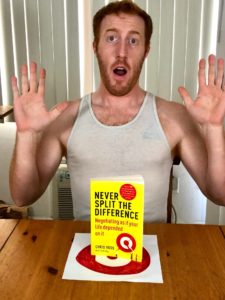 We are always negotiating. With our coworkers, our friends, our family members, and just about everybody else. The majority of our interactions are negotiations that essentially boil down to the expression of one simple, animalistic urge: I want. We are all constantly wanting things from other people, and it makes the world go round.
The first thing to know about negotiation is that it is all about emotional intelligence. “People tend to focus all their energies on what to say or do, but it’s how we are (our general demeanor and delivery) that is both the easiest thing to enact and the most immediately effective mode of influence.” It is important to understand that humans have two systems of thought. System 1 is our animal mind, which is fast, instinctive, and emotional; System 2 is our cognitive mind, which is slow, deliberate, and logical. We think we use System 2 to understand and interact with our world, but it is, in fact, our emotional System 1 that interprets the world and steers our thoughts first and foremost. The logical part, the one that developed later, comes in secondly and rationalizes the events of our lives in ways that we understand. Despite the development of our larger Homo Sapien brains, our animal brains are still in control of us. Knowing this information is necessary for being a good negotiator—and good communicator of any kind.
Once we understand our emotional brains, we can further learn how to influence and steer other people’s. Using our emotions as communication tools can gain us tremendous influence with others, something we want in any negotiation setting. For example, being able to detect anger and directing people away from it can be very useful. Anger is not usually a helpful emotion, as “it releases stress hormones and neurochemicals that disrupt your ability to properly evaluate and respond to situations.” It often comes up when someone is having trouble processing other emotions, which we can similarly help them label and process. You want your counterpart feeling relaxed and in control (whether or not they actually are) for the best negotiations.
One of the most effective tools that can be used in a negotiation is calibrated questions. These are open-ended questions that have no fixed answers like yes or no. Our author’s favorite calibrated question is: ‘How am I supposed to do that?’ It forces your counterpart to stop, think, and come up with an original answer. “The real beauty of calibrated questions is the fact that they offer no target for attack like statements do,” Voss writes. “Calibrated questions have the power to educate your counterpart on what the problem is rather than causing conflict by telling them what the problem is.” They are an opening for collaboration between both parties at the table. This is also an important piece of information to keep in mind: your counterpart across the table is not your combatant, they are your teammate. A negotiation is when both sides are working together to solve a common problem.
Another strategy I was happy to take away from this book was the importance of the word ‘No.’ We have all been trained from a young age to think that ’No’ is the end of debate, but ‘No’ seldom means “I have considered all the facts and made a rational choice.” Instead, it often means that the other side needs more time to consider their counteroffer. People (especially in negotiations) need to feel as though they are in control, and saying ’No’ allows them to do this by setting their boundaries. ‘No’ helps the other party (or yourself) clarify what is really desired by eliminating what is not.
Communicating with emotional intelligence, working together, and setting boundaries makes the art of negotiation analogous to the art of therapy. Our author agrees, detailing how a “psychotherapist pokes and prods to understand his patient’s problems and then turns the responses back onto the patient to get him to go deeper and change his behavior. That’s exactly what good negotiators do.” It’s about listening, empathizing, and collaborating on a mutually-beneficial course of action. This is true for negotiation, and it is also true for (almost) every human interaction we have on a daily basis.
- Inflation by Steve Forbes, Nathan Lewis, & Elizabeth Ames November 2, 2022
 Clocks measure time, scales measure weight, and money measures worth. The more money that someone is willing to pay for a good or service, the higher that good or service is valued.
If a banana was a quarter last month, and now it costs a dollar, logic tells us that the banana is worth more now than it was then. This is usually caused by either a dwindling supply of bananas or a rising demand for them. If the worth of the banana goes down, it could likewise imply that either demand has diminished or supply has grown too rapidly. Let’s say the supply has grown too much, leading to a lower value for bananas. This same principle holds true for money itself; too much money in circulation means that its value decreases.
The first example, when the price of the banana changes due to supply and demand, is called ‘non-monetary’ inflation and illustrates a healthy market economy. This is characterized by consumers spending their money where and when they want. The second, when the price of the banana goes up because the money needed to purchase it has less value, is an example of ‘monetary’ inflation, and also an economy that is not functioning properly. This is when government and banking officials have artificially altered the value of money.
The oversupply of money is one of the major causes of inflation, which is why, during periods of inflation, prices rise. It is not because things are suddenly more valuable, it is because your money is worth less.
This is one of the primary reasons why the Roman Empire fell (in addition to marauding tribes and corrupt officials) after hundreds of years of success and prosperity. In order to finance his wars and lavish lifestyle, the Emperor Nero would melt down the silver coins in circulation and add copper to them, ultimately diluting their purity and devaluing the currency. When societies used hard physical currency, this devaluation could only go so far, as there is a finite amount of precious metals on this planet. Today, however, things are much different.
It was Sir Isaac Newton, the famed physicist, who first introduced the gold standard to Great Britain (and the world) in 1717. Before he was put in charge of the Royal Mint, coins were hoarded, clipped into smaller pieces, and debased with other metals. Newton not only set a fixed exchange ratio for gold and silver, but he also set standards for weight and density to dissuade fraud. He officially fixed the value of one British pound to gold at three pounds, seventeen shillings, and ten-and-a-half pence (£3.89). Alexander Hamilton followed this same strategy in the latter part of the century when the United States was first founding; pegging the value of the US dollar to a certain amount of gold (or silver).
The gold standard lasted for hundreds of years and brought unprecedented wealth, capital, and prosperity to both countries and eventually the world as other countries followed suit. This was because money had a specific and trusted value and worth. This trust led to the Industrial Revolution and all the wonderful innovations we have today. Sadly, the 20th century brought world war, and with it economic disaster.
Britain went off the gold standard in 1931, and the United States eventually followed in 1971 under President Richard Nixon. We are now all exchanging ‘fiat currency,’ which is money not backed by anything stable (it was usually gold, but also sometimes other commodities). This allows the government to determine the amount of money in circulation, and, in effect, determine the value of money. The free market is no longer in charge: now it is up to the bankers and politicians. And what do you think happens when you give people the ability to print free money? They spend hugely, as Nero once did, and as the Federal Reserve does now. The difference is that while Nero only had so much metal to melt, the Fed can print money indefinitely. The US government is currently in debt to the tune of around $29 trillion.
While we are feeling the effects of inflation due to the Covid pandemic disruptions and other current global affairs (war in Ukraine), the reality is that it has been happening right under our feet for decades. And, “if inflation hangs around long enough, and becomes severe enough, it becomes a truly vicious cycle. The economy deteriorates.” You can look at Zimbabwe and Argentina as examples.
The authors of this book believe that the only way to avoid total economic fallout is to return to the gold standard. The common argument against this case is that there is simply not enough gold to back up all the dollars. But “the gold standard is not about ‘supply’ but about maintaining stable currency value. You don’t need to have piles of this precious metal for a gold standard to work. Gold simply serves as the anchor of value…the gold price is the barometer that enables you to maintain a stable dollar value.”
While many economists debate the pros and cons of returning to a gold standard, one thing is for sure: we need to stop printing money before it becomes entirely worthless.
- The Case Against Socialism by Rand Paul October 12, 2022
 If you were given the choice as to which economic system you would choose to live under, which would you pick, socialism or capitalism?
Socialism is defined as public ownership of the means of production, while capitalism is when the means of production are owned and operated privately. Most people preach and believe in one system over the other, when the reality is that each system has its own pros and cons. In his book, Paul exemplifies the problems with socialism and does his best to dissuade his readers from its implementation.
The reason why socialism has become a popular term in the West today is in opposition to the problems encountered by late-stage capitalism, i.e. income inequality. In capitalistic enterprises, owners have always made more income than employees. However, while that ratio is comfortable when it is 2:1, 5:1, 10:1, or even 20:1, it is now, in many cases, 200:1 and even as grandiose as 350:1. Indignation seems appropriate, and the people have turned to socialism as an alternative, although perhaps they don’t fully understand what this means.
If you read your history, it is true that pretty much every attempt at socialism by humanity has failed. Mao’s cultural revolution; Stalin’s worker’s utopia; even the Nazi’s were socialists—the political party brought to mainstream by Hitler was called the National Socialist German Worker’s Party. While these are empirically true facts, the type of socialism practiced by these regimes is not the kind of socialism often referred to by today’s political lefties. Yes, Mao and Stalin took the helm of the means of production, but they did it with force, eliminating anyone who didn’t go along with the program (ultimately hundreds of millions). Hitler infused his socialism with antisemitism and a desire for European domination. These examples of socialism are tainted with totalitarianism.
While capitalism does exacerbate inequality, it is also true that it’s tide has risen all boats. The rich are much richer than they ever were, but the poor are also much richer than they ever were. People in poverty in the United States still have homes with running water and a television. I have seen many homeless people in my home state of California who have cell phones. Poor people in Africa, who have not lived in a capitalist economy, still live in dirt shanties without plumbing or shoes. Capitalism gave humanity airplanes and the polio vaccine. It is why we in the West spend so little time cleaning our clothes (thanks, washing machine), whereas that chore used to take an entire day. Capitalism has created wealth for everybody, albeit distributed unequally. The people opposed to capitalism have a legitimate grievance: income inequality has gotten way out of control. Yet, it is also true that “Mao and Stalin and Hitler didn’t come to power promising tyranny. They came to power promising equality.”
Socialism, in the form of Maoism, Stalinism, and Nazism, is perhaps not a fair comparison because those men were power-hungry dictators bent on creating their own version of utopia. When military force is necessary to get the citizenry to adhere to your laws, you’ve got bad laws. So, many people on the political left point to Scandinavia as a place where socialism has worked and prospered, but Paul shows us that in fact, they are not traditional socialist countries. Many of them have open markets and private property and were in fact free market economies for decades. Sweden boomed from 1870 to 1950 “as a capitalist Mecca.” During this era, “Sweden was famous for defending property rights and free markets and enjoyed unprecedented economic growth.” It was only because of this cushion of capital that the Swedes were then able to support the welfare state that came into being after the 1950s. Do they have free college and universal health care? Yes. But also, anyone currently making over $60,000 pays about 60% of their income in taxes, while the truly rich pay closer to 80%, (with Denmark and Norway practicing very similar taxation). If you want to keep more of your hard earned money, you’ll want to live in the United States.
The desire for equality is a tricky thing. As the philosopher and economist Friedrich Hayak once argued: “from the fact that people are very different it follows that, if we treat them equally, the result must be inequality in their actual position, and that the only way to place them in an equal position would be to treat them differently.” So, for example, if you give two different people one hundred dollars, they will spend it differently. If you want them to spend their money the same way, you would have to calculate the correct amount to give each in order to instruct their spending (and then hope for the best, or, as history has repeatedly demonstrated, simply use force and make them spend it on what you want). Personally, I would argue that a utopia of equality is not something that we should ever truly want, for what would happen if we ever actually achieved it? Humans need something to strive for, and achieving a perfect utopia, or end state, would be the greatest death to any sense of purpose anyone could ever have.
Paul’s arguments against socialism are sound. For example, when the means of production are governed by one central government, the opportunity for corruption is tremendous. Fidel Castro, the leader of Cuba for 50 years, publicly pretended to be a man of the people while he was secretly worth hundreds of millions of dollars and claimed ownership of many immense properties, luxury vehicles and private planes. For another example, a common practice in socialism is when the government fixes commodity prices below the market value in order to make it more affordable for everyone. What ends up happening, however, is that producers stop creating and selling those commodities because they cannot make a profit. This in turn creates a black market encouraging violence, economic deceit, and eventually societal destruction—just look at Venezuela.
On the other hand, Capitalism can also cause some of these same problems. It is no secret that the wealthy elite in the United States literally avoid punishment for financial crimes to the tune of billions, while poor people ration the fruit and vegetables they feed to their children. The reality is that both systems create inequality, albeit in different ways. Swapping one for the other will not solve the inequality problem because the money and power in any system always concentrates at the top.
So, the case against socialism stands on firm legs: it is not a good way to organize an economy. But, ultimately, neither is capitalism. Both create inequality and mass societal issues, mostly effecting the poorest citizens. Capitalism may have the slightest edge, because it encourages innovation, but I don’t believe that either system is the ‘final solution.’ Hopefully, there is a synthesis of the two ideas that will emerge sometime soon and help alleviate both the societal problems we all face and also the calls for socialism.
- Solve for Happy by Mo Gawdat October 4, 2022
 Everyone wants to be happy. Regardless of who you are or where (or when) you were born, happiness is one of those things that all humans desire. The United States has it written into our constitution: “that all men are created equal, that they are endowed by their creator with certain unalienable rights, that among these are Life, Liberty, and the pursuit of Happiness.” The question remains, however, as to how we actually go about pursuing and achieving this often-unrealized state of happiness?
When you consider all of the emotional states that one can feel and consider, a vast majority of the negative ones are anchored in the past or predicting the future. Grief, envy, guilt and shame often come to light when we are analyzing past events. Anxiety, fear, doubt, and stress are all present in the mind when we think about the future. What are some emotions that occur in the present moment? Things like calmness and affection, contentment and relaxation.
“For human beings, simply put, the default state is happiness,” our author writes. If you’ve ever spent time with babies and toddlers, you know this to be true. They don’t have the mental capacity to consider what’s going to happen to them tomorrow because they are already overwhelmed with experiencing the present. Obviously, there’s a fair amount of crying and fussing, but as long as their most basic needs are met, they are freely emoting, experiencing joy and sadness as it happens, fully connected to what is transpiring in their immediate, tangible life. They are the perfect example of happiness.
A website called Trackyourhappiness.org ran a study with more than fifteen thousand participants, collecting more than 650,000 reports, and presented a profound discovery: regardless of what people were doing at any given time, they were noticeably happier when they were fully present. “It didn’t matter if it was a pleasant, a neutral, or an unpleasant thought; when they were focused outside the present, people were less happy. Period.”
This book review is short because the answer to being happy is to live in the present moment. While sometimes this is not easy, it really is that simple.