




I’m a writer and author with a passion for exploring ideas.
Since 2020, I’ve published monthly book reviews as a way to reflect on what I’ve read. I do my best to challenge my own thinking and remember the lessons worth keeping. Here you’ll find my books, my reviews, and my reflections on the ideas that have shaped my perspective along the way.
My Book
 |
Paradox PhilosophyAll things are in both harmony and tension with their opposites—we often choose certainty despite our doubts, fear when there is opportunity for hope, and ourselves when we might think of others—and we should always strive to find greater balance between them. We all want to live meaningful lives, hopefully lives of moral goodness, and philosophy is the study of this venture. Paradox Philosophy is a modern, Westernized version of Yin Yang theory that delivers wisdom towards living a more virtuous life. Available at: |
Book Reviews
- A People’s History of the United States by Howard Zinn September 28, 2023
 History is subjective. It is written and recorded by both regular people and historians, all of whom have their own personal biases, interpretations of events, and beliefs, regardless of how conscious they are of trying to be objective. No account of history escapes this phenomenon.
This brings an important question to light: Whose account of history have we been taught? For many of us, especially those of us taught in public schools, it is the version approved by people in positions of power. In A People’s History of the United States, our author Howard Zinn does the opposite, telling history from the point of view of the powerless.
It starts with Columbus meeting the Native Americans in the late 1400’s. Many textbooks teach that he discovered new lands and new people and became economic partners with them. Through a European lens, this is true. If we consider this initial meeting through the eyes of the native people, however, we might interpret events differently. Columbus could not have discover America, the continent was already inhabited by millions of indigenous people. Did they trade peacefully? Perhaps at times, but Columbus’ men also enslaved many of the natives and treated them with extreme hostility. This same trend played out repeatedly as more Europeans sailed west and encountered the Native Americans. The Spanish and Portuguese subjugated the people of South and Central America, whilst the English subjugated those in the North.
Perhaps we know a bit of this history, and recognize that European-Native American relations were more antagonistic than harmonious. This, again, is only a partial truth, as “more than half the colonists who came to the North American shores in the colonial period came as servants.” Subjugation was not only reserved for the Native Americans, even many white men and women were oppressed by their own European elites. It was a society in favor of the few at the expense of the many. This, more than anything, is the theme of this book.
Zinn proposes that the history of The United States is a history of dominance by the elite classes over Native Americans, Blacks, Latinos, Asians, women, those living in poverty, and pretty much anyone without the ability to resist. Not only was this dominance financial, with the elite class keeping the wealth created by the labor class for themselves, but it was often physical and emotional as well. When movements of poor and working class people coalesced and petitioned for more rights and better working conditions, they were often met with imprisonment, violence, and death. The following are statistics from this book that illuminate these trends:
In 1770, in Boston, the top 1 percent of property owners owned 44 percent of the wealth.
In 1820, 120,000 Indians lived east of the Mississippi. By 1844, fewer than 30,000 were left.
Between 1790 and 1860, the number of slaves grew from 500,000 to 4,000,000.
In 1877, 100,000 workers went on strike against the railroad companies.
In 1886 there were over 1,400 strikes, involving 500,000 workers.
In 1914, the income of 44 families making $1 million or more equaled the total income of 100,000 families earning $500 a year.
During World War Two, there were 14,000 strikes involving 6,770,000 workers.
In 1950, the military had a budget of about $12 billion out of a total US budget of about $40 billion. In 1960, the military budget was $45.8 billion—49.7 percent of the total budget.
In 1961, about 200 giant corporations out of 200,000 corporations—one-tenth of 1 percent of all corporations—controlled about 60 percent of the manufacturing wealth of the nation.
In 1977, the top 10 percent of the American population had an income thirty times that of the bottom tenth; the top 1 percent of the nation owned 33 percent of the wealth.
On June 12, 1982, 1,000,000 people gathered in Central Park, New York City, to express their determination to bring an end to the arms race.
In 1990, the average pay of the chief executive officers of the 500 largest corporations was 64 times that of the average worker. By 1999, it was 475 times the average worker’s pay.
In 1998, one of every three working people in the United States had jobs paying at or below the federal poverty level (from the Bureau of Labor Statistics of the U.S. Census Bureau).
Zinn asserts that the history of The United States is a history of control by the elite class. Consider the founding fathers: They were nearly all lawyers by profession and were “men of wealth, in land, slaves, manufacturing, or shipping.” Forty of the fifty-five men held government bonds, according to the records of the Treasury Department. These men were obviously from the elite class, which begs the question: If they were truly determined to compose a Constitution that ensured equally for all, why were no slaves, women, servants, or men without property allowed to be a part of the writing process?
Consider a recent presidential election: In 1980, Ronald Reagan received 51.6 percent of the popular vote while Jimmy Carter received 41.7 percent. These numbers look good until you factor in the reality that “only 54 percent of the voting-age population voted, so that—of the total eligible to vote—27 percent voted for Reagan.” A democracy is supposed to be a system of government in which the people govern themselves by electing representatives from amongst their ranks. However, if half of eligible voters don’t bother to participate and don’t believe in the system, is it really a democracy? The country was thus presided over by a man who was selected by just over one-quarter of the citizenry. In his first term in office, Reagan cut $140 billion dollars in social programs while simultaneously increasing the ‘defense’ budget by $181 billion. He clearly cared more about allocating money for the military industrial complex than for the poor.
A People’s History of the United States is a long and methodical book—it covers events from colonial times up to the 2000 presidential election and the “war on terror.” It is a necessary alternative to the versions of history proposed to many of us in school and should be taught in conjunction with them. The question that came to my mind when I finished reading it was this: Is the story of The United States a story about liberal democracy or a story about elite power?
- The Boys in the Boat by Daniel James Brown September 20, 2023
 This book is a lively and fun read about the young men who rowed crew at Washington University in the first half of the 20th century, eventually winning gold at the 1936 Olympics in Hitler’s Germany. It is centered around one particular rower, Joe Rantz, and his struggles in the economic depression of the late 1920’s. Through pure perseverance, he manages to survive a traumatic childhood, earn enough money to get himself a University education, get married, have a family, and live a happy life (along with winning a gold medal at the Olympics). His story is truly inspiring, a testament to what any one of us might achieve if we set our mind to it.
While most reviews of this book will focus on the sport of rowing or the Nazi’s use of propaganda to convince the world they weren’t an authoritarian government bent on ethnically cleansing their country, I’d like to take a different angle. For me, the arc of this book was Joe Rantz’s transformation from a lonesome man doing his best to survive to a man integral to the group in the boat. It is the story of a fierce individual finding a community which loves and supports him, and in fact would have been unable to win without him.
In the sport of rowing, there is a term called ‘swing,’ which is when all eight rowers are in such perfect unison that not a single action is out of sync; all operate as one. Obviously, this can be an incredibly difficult thing to achieve, and while each individual rower’s strength and abilities are important, it is this harmony, more than anything else, that predicts a crew’s success on the water. This was the psychological journey traveled by Joe Rantz, from an individual to a member of the crew, and it is a metaphor I believe we can all appreciate.
We are all individuals, and we are all members of a myriad of social groups, and I believe that finding the balance between these two psychological entities is paramount to living a happy and healthy life. The crew of a rowboat (called a shell) is a perfect metaphor. Each member must practice their technique and build their individual strength in addition to pulling in sync with the others. We may not be in an actual boat, perhaps our metaphorical boat is an office or a family, but we must likewise sharpen our own skills in addition to working in sync with others. While some of us are too individualistic and some of us are too community-oriented, we must all find a balance between the two, because without it, our boat will surely capsize.
- Blue Ocean Strategy by W. Chan Kim and Renée Mauborgne September 6, 2023
 The best way to be noticed by others is to differentiate ourselves from the rest of the group. This rule applies across the board, whether it be in dating, entertainment, business, politics, etc. In dating, this is the act of peacocking, which is when someone wears clothing that makes them visually stand out from everyone else at the bar—a leopard print shirt perhaps. The rapper Eminem became one the most popular music acts in the world because he was a white artist in a predominantly black genre. In politics, part of the reason Donald Trump has become so popular is because he talks and acts differently than everybody else.
Blue Ocean Strategy is about applying this same principle in business. When industries become overcrowded, choosing between similar brands becomes harder and harder for consumers, and “people increasingly select based on price.” Buyers won’t stick to their preferred Colgate toothpaste when Crest is on sale, and vice versa. Most businesses focus on trying to differentiate themselves from their competition—perhaps adding mint, whitening capabilities, or fluoride to their toothpaste. This may give them a slight edge, but the competition will catch up. When market space is crowded, our authors refer to it as a red ocean—one that is ‘bloody’ from competition.
Instead, our authors suggest a new strategy called value innovation. Value innovation is when a company introduces new strategies, upgrades, or technologies that are designed to achieve both product differentiation and low costs. It’s not enough to simply create a new product or service, it must also be cost effective for both provider and consumer.
The Canadian circus and entertainment company Cirque du Soleil created a blue ocean by following this strategy. Whereas circuses are geared towards children and theater is for adults, Cirque du Soleil combined them both, “offering people the fun and thrill of the circus and the intellectual sophistication and artistic richness of the theater at the same time.” Traditional circuses featured star performers, animal acts, and three rings. Cirque du Soleil did away with all of these. They kept the artistic music and acrobatic dance, but added in themes and story lines, something more akin to a theatrical production on Broadway. It was designed for viewers of all ages, offering multiple productions instead of the ‘one for all’ show. Through these strategies, Cirque du Soleil created an entirely new market of entertainment seekers: people who would have previously never considered going to the circus or theater on a night out. They brought production costs down without the star names and expensive elephants, which in turn made ticket prices affordable, and simultaneously “invented a new form of live entertainment, one that is markedly different from both traditional circus and theater.”
Instead of focusing on how to keep an existing customer base, blue ocean strategies pursue non-customers and create entirely new markets for themselves. They recognize that the best way to “beat the competition is to stop trying to beat the competition.” Another blue ocean business examined in the book is the Australian wine company [yellow tail]. Traditionally, wine was marketed towards upper-class buyers and thought to be a sophisticated drink, complete with high price tags and fancy looking bottles. [Yellow tail] turned this idea on its head, offering cheap options in non-threatening bottles and making wine easily accessible to the average drinker. Sales for the first few years were phenomenal before competitors inevitably appeared, competed in the market space, and turned their blue ocean into a red one. All blue oceans become red eventually.
All things exist in a state of flux and businesses are no different: they come and go with how society changes over time. In order to stay relevant and profitable, both new and existing businesses must constantly innovate. This process of creating new value, finding new markets, and delivering at an appropriate cost for consumers is what blue ocean strategy is all about.
Don’t be afraid to think outside the box! Whether we are in business or not, differentiating ourselves from the group is a theme we can all embrace. We are always attractive if we are doing the thing that nobody else is doing, in business, and in life.
- The 50th Law by 50 Cent and Robert Greene August 23, 2023
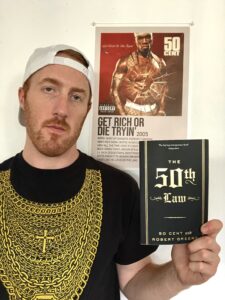 We all have fears. Will we get a good job? Will we find love? Will we ever make it out of our current situation in life and achieve something different, something better? The future is perpetually uncertain, and our anxieties about its various potentialities can cause us to make poor decisions in the present. We often let our fears inhibit us and cloud our judgment.
When we are born, our very first emotion is fear. As newborn babies, we have no control over any aspect of our lives, and we are inherently scared that our needs will not be met. Fear is our first reaction to life, the “oldest and strongest emotion known to man, something deeply inscribed in our nervous system and subconscious.” Out of this fear, babies necessarily make everyone else cater to their needs and desires. They cry, and mom (or dad) comes running with the food or diaper change. Because of this, fear becomes something that we try to assuage and avoid, an uncomfortable feeling that must be mitigated.
There is another way, however, one examined and expounded upon by rapper-entrepreneur 50 Cent and writer Robert Greene in this co-authored book: accept our fears, embrace them, and make them work for us. The goal should not be to eliminate them, for that makes us soft. Instead, we must face them directly, with courage and strategy, and we will undoubtedly emerge from our trials and tribulations stronger.
Growing up in Queens, New York, 50 Cent never should have escaped the street life. His mother was murdered when he was only 8-years-old and he was on the corner selling drugs before puberty. How did he ever manage to make a name for himself in music and then business? He out-hustled the other young men on the corner, using a combination of savvy business schemes (like skimming product off the drugs he bought from his supplier in order to start his own hustling gig) and calculated violence (he once slashed a competitor’s face with a razor blade to send an intimidating message to the rest of the hood). By the age of 24, he had managed to sign a record deal with Colombia Records and his first album was set for release.
Despite this glimpse of freedom, in May of 2000, his street life caught up with him when a hired assassin fired nine bullets into his body from close range and left him for dead. Miraculously, he survived, only to be dropped by Colombia and see his future success go up in smoke. Did this stop the fearless 50? Absolutely not. It only made him work harder, for he had faced death and lived. He began an underground mixtape campaign on the streets of New York that led to Eminem and Dr. Dre signing him to their label only two short years later.
This book is broken down into ten chapters, each a different element of fearlessness, culminating in the ultimate fear: the confrontation of our own mortality. Each of these lessons is expanded upon via the stories of 50’s growth from a hustler on the streets of Queens to a platinum-selling rapper to a business entrepreneur, in addition to Greene’s analysis and inclusion of other relevant stories from history. It is a wonderful tapestry, with 50’s life used as the colors and patterns and Greene acting as the artist.
Today, 50 Cent is worth millions. He has sold tens of millions of records, performed around the world, invested in multiple companies including clothing, books, and beverages, and is currently executive producing multiple television shows. Every time life has intimidated him with its punishing unpredictability, he has taken the challenge head on and never doubted himself. He sees the harsh realities of his life for what they are and works within their parameters. Every time events turn to shit, he turns them in sugar.
50 Cent is living proof that if a simple street hustler from the hood can make it to the top, we can all improve our lives to the extent that we believe in ourselves, work our corners, and face our fears. After all, the “most intense form of self-belief is to feel a sense of destiny impelling you forward.” We must see things for what they are, master our crafts, and never stop moving forward. We must never let our fears stop us from action.
Franklin Delano Roosevelt was resoundingly right when he famously stated that the only thing we have to fear is fear itself.
- Animal Farm by George Orwell August 3, 2023
 This tale of animals on a farm is an allegory for totalitarianism, reflecting the events before and after the Russian revolution of 1917. First published in 1945, just after the Second World War, it was written at a time when England and the Soviet Union were allied against Adolf Hitler and the Third Reich. While these two nations worked together to bring Europe to peace, our author (George Orwell) remained critical of Joseph Stalin and his socialist agenda. It was only after the hot war in Europe ended, and the Cold War began, that public sentiments towards the Soviets began to change and this book found its audience.
This allegorical novel starts with a call for revolution by an old white boar on the farm, someone whom all the other animals respect. Feeling mistreated by their human farm owner, the animals do revolt, and suddenly find themselves in possession of all the land. What first is a happy moment of freedom quickly spirals out of control as a new order is set up by the ‘smart’ animals, which are the pigs. The two most influential pigs are modeled after Joseph Stalin and Leon Trotsky, with the Trotsky-pig chased away rather quickly (Trotsky was murdered in real life) and a dictatorship set up by the Stalin-pig in his wake.
At first, things are good. Everybody receives plentiful portions of food and no longer feels the whip on their backs while they work. When the humans return to retake the farm by force, the animals work together to fight back and win, with honors bestowed upon their bravest warriors. The rules of the new society are written on the barn in white paint, clearly defined and agreed to by all. Yet, as soon as precedent is set, things begin to change. The surplus milk that the cows were promised to keep for themselves goes missing, and it has been given to the pigs in charge. The apples are soon delegated to the pigs as well, and the eggs are taken from the chickens. The animals are asked to work extra hours to build a windmill that will benefit them all, but those who decline the work are also declined their rations of food. The rules on the barn are edited and repainted. The Stalin-pig demands to be referred to as the Leader, and before they know it, a new dictatorship has taken hold of the farm.
All the classic authoritarian abuses of society are present in these pages. Most important is the use of information and the psychological reprogramming of the less-educated farm animals. The pigs in power rewrite the history of the revolution and use propaganda to convince the other animals that life is better now than it was before. The sheep believe the pigs right away. As time passes, the other animals progressively forget more and more of their life on the farm before the revolution, and eventually come to believe the propaganda as well. The use of scapegoats is also present, as everything that goes wrong is blamed on the Trotsky-pig, despite the fact that he has not been seen in years. Having a recognizable enemy makes consolidating power easier.
By the end, nobody remembers the past, all the rules have all been changed, and the pigs are wearing human clothing and using whips just like the human farmers before them. They take everything produced by the farm for themselves and allow the rest of the animals to have just enough to survive and work. This, of course, sets the stage for another revolution.
As we know from history, the Soviet Union collapsed under the weight of its own lies and inefficiency. Sadly, this was not before millions died of starvation or in a Gulag labor camp. What is scary about this allegory are the links that can still be drawn to our 21st century society: The desire for more power by those who already hold the most; the use of propaganda to change people’s minds and rewrite history; people’s inability to tell what is true and what is false; the promises of a better future with no concrete plans to achieve it. This allegory is over 75-years-old, and yet, it remains a narrative warning that we should all heed.