




I’m a writer and author with a passion for exploring ideas.
Since 2020, I’ve published monthly book reviews as a way to reflect on what I’ve read. I do my best to challenge my own thinking and remember the lessons worth keeping. Here you’ll find my books, my reviews, and my reflections on the ideas that have shaped my perspective along the way.
My Book
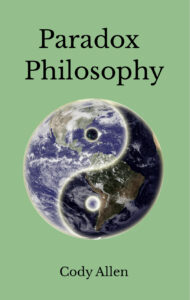 |
Paradox PhilosophyAll things are in both harmony and tension with their opposites—we often choose certainty despite our doubts, fear when there is opportunity for hope, and ourselves when we might think of others—and we should always strive to find greater balance between them. We all want to live meaningful lives, hopefully lives of moral goodness, and philosophy is the study of this venture. Paradox Philosophy is a modern, Westernized version of Yin Yang theory that delivers wisdom towards living a more virtuous life. Available at: |
Book Reviews
- Amusing Ourselves to Death by Neil Postman July 8, 2021
 In January of 1776, Thomas Paine published a book called Common Sense: The Origin and Design of Government. It sold 100,000 copies in the first two months. Today, a book would have to sell 11,000,000 copies to match the proportion of the population that Paine’s book reached. Common Sense went on to print somewhere between 300,000-400,000 copies, equivalent to somewhere between 33,000,000-44,000,000 people today. As Postman notes in Amusing Ourselves to Death, the “only communication event that could produce such collective attention in today’s America is the Superbowl.”
In the mid 1800s, Abraham Lincoln and one of his political adversaries (Stephen A. Douglas) used to have public debates that lasted hours. Each participant would get a minimum of an hour of speaking time before the other rose for a rebuttal, and debates could often last upwards of 4 hours. What is even more remarkable is that the audience of regular common people was rapt with attention for the entire affair. Today, politicians are given 1 minute to give an opinion on a major issue and their opponent is expected to keep their rebuttal to 30 seconds.
So, there is a definitive difference in the mainstream intelligence of people from our past in comparison to people today. How did this come to be? Postman posits that it is due to the rise of television as our main source of information gathering. In the 17th and 18th centuries ideas were shared via writing (and if you go back father, to the days of humanity before writing and reading were wide-spread, when ideas were only shared orally, the scholars and politicians of the day were those select men with a knack for oratorical skills.) Postman notes how the first fifteen presidents of the United States most likely wouldn’t have been recognized by their citizens on the street, yet those same citizens could have identified them by their latest speech or piece of distributed writing. Today, things are quite different. Postman wrote this book in the 1980’s when Ronald Reagan was president—a man who was previously a big time Hollywood actor in the 1960s and built a national reputation as someone on the silver screen. Even more recently we endured the presidency of Donald Trump, the former host of a reality television series. Was Donald Trump a good politician? The debate is still out. Is he entertaining? Absolutely—he is the most entertaining politician we have ever had in the age of television and I personally am not surprised at all that he is the most popular politician in the United States right now.
The core argument of Postman’s book is not only that television changed how we receive information, but it changed our entire relationship to information on an epistemological level. Whereas writing is geared towards conceptual thinking, sequential order, careful reasoning, objectivity, and a delayed response, television is meant for entertainment. Television, with its constantly moving pictures and engaging sound effects, is meant to be amusing. When we indulge in TV for entertainment’s sake, sinking into the couch after a hard day’s work to watch our favorite half hour comedy, that is not the TV that Postman is talking about. The TV that has decimated attention spans and amused us to a breaking point is the TV that has infiltrated our religions, our politics, and our education systems. “As a television show, and a good one,” Postman writes, “Sesame Street does not encourage children to love school or anything about school. It encourages them to love television.”
With television’s incorporation of the news cycle, our ways of learning about the world are also stunted. We get a story about the Middle East, and then a minute later we’re hearing about gridlock in the Senate, quickly followed by a story about a dog riding a crocodile in Florida. These are all entertaining stories to be sure, but what do they all have in common? For 99% of us, they have no impact on our daily lives. Do I wish there was less violence in the Middle East? Of course. What can I actually do about it? Essentially nothing. With all the graphic images and sounds coming out of the television screen, however, it is incredibly engaging and I can’t look away!
Television is designed to make everything it touches entertaining, and it has infiltrated our culture so much so that with the advancement of the internet and social media, the trends in this book have only exacerbated. “The form in which ideas are expressed affects what those idea will be,” Postman writes, and I couldn’t agree more. We the people now expect everything in life, whether it be news, politics, science, education, commerce, religion, etc., to entertain us. If it doesn’t, we don’t want it. Personally, I believe that our culture would benefit tremendously from a return to typography—a large part of the reason why I started reading and writing book reviews in the first place. Books are where real education lies, and in my opinion a better education is the way towards a better future. The internet has recently made huge swaths of information readily available (thanks Wikipedia!) so we now must take focus from what we are learning and return focus to how we go about learning it.
- Sapiens by Yuval Noah Harari June 29, 2021
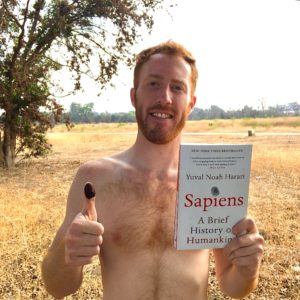 While this book has many interesting historical tidbits and anecdotes (for example, the first recorded human name was an accountant, not a king, priest, or warrior) there is only one piece of information that needs to be strongly considered, as it is the thesis of this book: What sets Homo Sapiens apart from all the other animals who have ever walked the earth’s surface? The answer is our ability to collectively formulate and believe in shared ideas. This is scientifically known as inter-subjectivity. In his book, Harari gives the example of a regular subjective belief: a child who has an imaginary friend. This belief hinges on just one person, and as soon as the child stops believing, the imaginary friend ceases to exist. Inter-subjectivity is this same phenomenon applied to a group of people. If ten people believe in an imaginary person, and one of them stops believing, the imagined person still exists, because the remaining nine people keep it alive. Harari then applies this to any and all institutional creations of mankind, including law, money, religion, countries, companies, free-market capitalism, liberalism, the family unit, the Lakers Basketball team, Wal-Mart, high school, et cetera ad infinitum.
A stark reality about our lives is that everything that is, was, or will be, originated in the mind first. We could not sharpen rocks to make knives before we had the idea to do so. This is an uncomfortable realization, because it means that literally everything we know of today is, in a way, fiction. McDonald’s didn’t exist before the McDonald brothers and Ray Croc came up with the idea for an affordable burger restaurant. The rule of law, the value of money, and the belief in God(s) follow this same logic. All of these things occurred in the mind of a Homo Sapien before they developed into the institutions and ideas we know them as today. If any one person stops believing that McDonald’s has good burgers, or stops believing that the laws of their country are fair, the overwhelming majority of other people who keep believing keep them running. Collective belief is a powerful thing.
While this book has less scientifically proven results than your standard book on evolution, what Harari offers instead are reasoned arguments for both sides of many historical coins. For a fun example, he notes how “in medieval Europe, aristocrats spent their money carelessly on extravagant luxuries, whereas peasants lived frugally, minding every penny. Today, the tables have turned. The rich take great care managing their assets and investments, while the less well-off go into debt buying cars and televisions they don’t really need.” For a more sober example, take the cultural ideas that money is the root of all evil, that religion drives people apart, and that the empires of old and new are built on blood and tyranny. Those things may all be true, but what if the opposite was also true, that these three things are actually the greatest unifiers of human history? Money is arguably the single greatest idea that humankind has ever come to collectively believe in, and it is this universal belief that midwifed the modern economy we know today. It is why the first recorded ancient texts were numbers. Similarly, organized religions have produced both wonderful and horrific results. On one hand, there have been an uncountable number of wars fought and lives lost getting other people to believe what the powerful want them to believe. On the other, bringing more and more people together under a similar umbrella of say, Christianity, Judaism, or Islam, has led to an overall greater peace, as people have assimilated into believing in the same grand ideas. This is also how society has been able to increase in size. Three thousand years ago, two different people from two different corners of the planet would have been strangers and most likely enemies had they had the fortune to meet. Today, two strangers from across the planet can meet each other in an airport, discover that they both believe in the same God, political ideology, or football team, and instantly have a connection. This leads into another theme of the book, which is the idea that humanity is always progressing towards unification. Harari writes how “from about 2 million years ago until around 10,000 years ago, the world was home, at one and the same time, to several human species.” Today, there is only one. Likewise with religion, when humanity was segregated by continent, country, region, kingdom, city, village, and tribe, they each had their own independent structures of beliefs. Today, there are far fewer religions (albeit with numerous different sects), but larger numbers of people believe in them, and there is thusly a larger shared consciousness amongst a wider range of people. The technological revolution of our current lifetime has further unified the world via the now instantaneous global-transferability of information.
So, what sets Homo Sapiens apart from all the other animals on the planet? Somewhere around 70,000 years ago, Homo Sapiens began developing larger and smarter brains enabling them to construct larger and smarter ideas and work together. Harari refers to this period of time as the Cognitive Revolution. This is how humanity has come to consistently grow as a species, to ultimately dominate the globe, and why it always will. What does it mean to be a Homo Sapien at its utmost core? Believing in something that someone else also believes in.
- The Untethered Soul by Michael A. Singer June 19, 2021
 This book is the modern day guide to getting in touch with your inner self. While reading it, I came to recognize two different entities inside of myself. One does the talking and one does the listening. The talker (my ego) talks a big game. He is unabashedly bold and thinks his shit don’t stink. The listener (what I have come to understand as my true self) is bad at pushing back against my ego when it goes too far. Reading this book brought the relationship between these two aspects of my inner self into a realm of greater personal understanding.
This book also really made me appreciate the tremendous power of the mind. Singer uses the allegory of a house in a beautiful field to describe how many of us live our mental lives. The house is “all your past experiences; all your thoughts and emotions; all the concepts, views, opinions, beliefs, hopes, and dreams that you have collected around yourself.” We stay inside our houses because they are safe. But, if we manage to open a window, or break down a wall, we would be faced with the beauty of the outside world. This of course goes hand in hand with change. Breaking down the walls of our conceived houses is equivalent to embracing change and facing our fears. In practice, it is very difficult to do because fear is scary. If we can manage to get to the other side of it, however, and see our fears in a different way and change our thoughts and perceptions that surround it, the field of view is truly breathtaking.
The theme of succumbing to our fears comes up a few times, as Singer notes that “if you have a lot of fear, you won’t like change. You’ll try to create a world around you that is predictable, controllable, and definable.” He goes on to say how in reality, “fear is the cause of every problem. It’s the root of all prejudices and the negative emotions of anger, jealousy, and possessiveness.” Anybody familiar with Star Wars should be hearing Yoda in their heads right now telling young Anakin Skywalker how “fear leads to anger, anger leads to hate, hate leads to suffering” (and ultimately to the dark side.) Singer and Yoda are saying the same thing: If you let fear be in the drivers seat, you will spend your life perpetually unhappy, always trying to shape external events to fit your internal narrative and soothe your psyche. The way through this is to embrace change and recognize that “if you really want to break through, you have to be willing to just watch the fear without protecting yourself from it. You must be willing to see that this need to protect yourself is where the entire personality comes from.” Fear is what builds the allegorical house. If you want to step outside and feel the warm sunshine on your skin, you must accept that life is full of scary things and you can realistically do very little (oftentimes nothing) about it.
I have noticed this in my dating life. When I’m dating somebody who I really like a lot, and I get scared of losing out on a potentially great relationship with them, I act in ways that often encourage that very outcome. When I date with an ‘I’m going to be my best self and let the chips fall where they may’ attitude, I am always comfortable with the result, regardless of whether it is successful or it doesn’t pan out. I have noticed it in my professional life as well. When I was a younger artist, I used to have tremendous fear that people would never listen to my music or read my writing, and so I sat on it. Eventually I couldn’t anymore and I started putting my creative self our there into the world and the results have been inspiring and encouraging. I now have no fears about how my art will be received because I create it for myself first and foremost. I have also noticed fear in the political actions of friends and relatives. A lot of my family members are Democrats and support the Democratic Party here in the United States. The media uses fear to make them scared of the big bad Republicans and what they might do if they gain too much power. It leads them to hate members of the other political party. My own sister thinks all Republicans are racist, sexist, and homophobic. How many Republicans does she actually know in real life? Not many, most likely none at all. Republicans are the same way, stoking fears of Socialism in order to strengthen their party, which, although effective, also causes their constituents to hate liberals. Everybody is building houses in order to protect themselves from things they are scared of, when it seems to me that we should be breaking the walls down and embracing change.
This book taught me to take notice of my internal energy and gave me confidence that dealing with it is always the better route to take instead of hiding it and letting it fester. Last year, when I turned 30, I booked a flight to Atlanta, Georgia, to visit an old friend from childhood. He turns 30 about two weeks after me and we hadn’t seen each other in years. Sadly, our relationship wasn’t quite what I expected, and we were not as emotionally available with each other as I had hoped. He said some things and acted in some ways that didn’t sit right with me and instead of talking about it, I buried it in an effort to make the short trip as fun as possible. When I got home, I told myself I would wait a week or two and then call him up to talk about it. I ended up waiting 8 months! We communicated many times over those 8 months and I never brought it up. It chewed at my psyche for the entirety of that time, and now that the experience is in my past, I feel downright stupid for letting it sit within me for so long. This man was my best friend for the first 18 years of my life (before college sent us in different directions) and even though we were not as close as we once had been, I was scared to talk openly and honestly with him about my feelings. Because of this, my inner monologue kept me up late on many occasions and bothered me constantly. Once I got the courage to speak with him he was open and receptive to my thoughts and we shared a lovely two hour conversation about the birthday trip and moved past it. I came to this book much later, but the ideas Singer proposes struck this chord with fervor. If you harbor energy that you know is making you emotionally unhappy or unstable, the best strategy is to find a way to release it. Usually this means sharing it with a loved one and finding strength in empathy. It also means finding empathy for yourself. I now make a practice of approaching uncomfortable topics as soon as I recognize them within myself because “stress only happens when you resist life’s events.” My life is infinitely better because of it.
The way forward for me in overcoming my external fears and soothing my internal stressors has been about recognizing when my ego is talking and when my listener isn’t talking back enough. This, I believe, is the essence of this book. Getting in touch with yourself is the pathway forward through the trials of life because life will be stormy no matter what you do. Who you are in relation to the storm is what counts.
- Oliver Wendell Holmes by Stephen Budiansky June 9, 2021
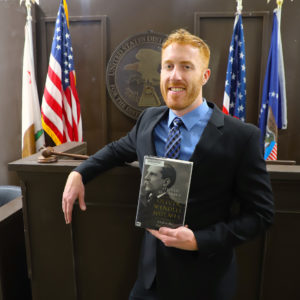 Oliver Wendell Holmes Jr.’s life can be divided into three clean-cut chapters: he fought in the civil war (wounded three times), he sat on the Massachusetts Supreme Judicial Court for twenty years (1882-1902), and then he sat on the United States Supreme Court for thirty years (1902-1932).
My biggest take away from this book was the idea that the Constitution is a living and breathing document that should evolve and adapt in step with society. I had heard the phrase ‘living document’ before, but as someone with no formal education in the law, I had never really considered what it actually meant. “The provisions of the Constitution are not mathematical formulas having their essence in their form; they are organic, living institutions” Holmes wrote in one of his Supreme Court case opinions, “it is to be gathered not simply by taking the words and a dictionary, but by considering their origin and the line of their growth.” Holmes was a firm believer that judges had a responsibility to examine how laws operated in real world contexts, and not how they appeared on paper. This same approach would be adopted by numerous court judges who followed in his footsteps, most notably Thurgood Marshall—the first black justice to sit on the United States Supreme Court—who once gave a speech titled: The Constitution: A Living Document.
Holmes is one of the most famous Supreme Court justices in United States history because of his record of dissents. His dissents “not only feature prominently among the classic opinions in the annals of the United States Supreme Court,” but “time and again, became the majority view a decade or more later.” His first major dissent on the Supreme Court came in the 1905 case Lochner v. New York. In it, a New York law limited bakery employees to working only 10 hours a day and 60 hours a week. Joseph Lochner, a prominent baker from upstate, believed the law to be unconstitutional. The case eventually was brought to the Supreme Court in which a five-judge majority decided that the law violated the fourteenth amendment, citing that it breached “the right and liberty of the individual to contract.” Holmes disagreed, writing that the “word liberty in the Fourteenth Amendment is perverted when it is held to prevent the natural outcome of a dominant opinion.” He believed that the Fourteenth Amendment did not embrace laissez-faire economics (defined as minimal governmental involvement) and that if New York’s legislators passed this law on behalf of the betterment of its citizenry, it was shameful for the Supreme Court to overturn it. In his book The Common Law, he wrote that “The law should be based on external standards of conduct rather than subjective moral judgments.” In 1955, precisely fifty years later, in a case involving state licensure of optometrists in Oklahoma, the court ruled in favor of the state with the majority opinion noting that “the day is gone when this court uses the Due Process Clause of the Fourteenth Amendment to strike down state laws.” While Lochner was Holmes’ first major dissent that would prove prophetic, it would not be his last.
Another of his famous dissents came in the 1919 case Abrams v. United States. In this case, a number of Russian Jews (all living in America) had been arrested and sentenced to prison for distributing pamphlets denouncing the United States for aiding the revolutionary Bolshevist movement in Russia. The court ruled 7-2 in favor of the sentencing, the majority opinion being that the offenders had incited revolutionary thoughts against the US government and had undermined the national war effort to detrimental effect. While his fellow justices encouraged him not to dissent, Holmes wrote a blistering one. In it, he advocated for the free speech of individuals under the First Amendment in addition to “introducing the notion of the free trade of ideas.” (He also believed the defendants had been unfairly prosecuted due to their Judaism.) The reason this case was a landmark one was because it came about during a time of intense social anxiety—it was directly a result of the United States’ involvement in the First World War and subsequently the Bolshevik campaign in Russia. It seems to me to be no coincidence that it happened at a time of national (and global) turmoil, when people were living through a heightened state of fear and instability. The coronavirus pandemic of our own time is our equivalent and the same national conversations about speech are being had today. What constitutes ‘clear and present danger’ when it comes to the spoken word? Where do we draw the line between censoring truly harmful speech and not trampling on people’s first amendment right to express their opinions? One hundred years ago Oliver Wendell Holmes drew his line and it is now up to us to draw our own.
Throughout his career on the bench, Holmes argued for “upholding legislation regulating workers’ wages and hours, banning child labor, restricting labor injunctions and yellow-dog contracts, and protecting consumers.” While his decisions were not always embraced by the majority of justices at the time, they were often adopted in later years as membership on the court (and society as a whole) became more progressive. Holmes reached his conclusions not “from a political concern with the outcome, but from his deep study of the law and its purpose in society.” He had a remarkable knack to see where society was heading and always did his best to steer his judicial opinions in that direction. We are undeniably a better society because of him and his exceptional contributions to our understanding and practice of the law.
- A Brief Natural History of Civilization by Mark Bertness May 31, 2021
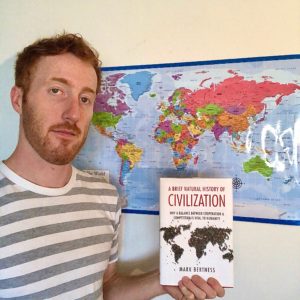 If you were to ask any average person on the sidewalk the difference between plants and animals, the list of answers is obvious. An interesting truth, however, is that “self-replicating life evolved only once on our planet, because all organisms, from viruses and bacteria to humans, are designed according to the same genetic rulebook and feature the same DNA programming language.” While our subconscious accepts this notion, it is a hard one to understand in our rational mind. Humans, whales, redwood trees, mustard seeds, coral reefs, and coronavirus are all descendants from the same microorganisms that started life hundred of millions of years ago. Such a timeline is hard to imagine. To help us conceptualize this timeline, the great scientist Carl Sagan once wrote: “If the history of the earth were compressed into a twenty-four-hour day…civilization would begin just a few minutes before midnight.”
The history of civilization on this planet is one marked by both competition and cooperation. Darwin’s theory of evolution is based around the competition of genes in a gene pool and how the strongest will always outlast the weak. When two similar species (or tribes of the same species) need the same scarce resources in order to survive, they must inevitably compete. On the other hand, those species would not exist without the cooperation of early microbes that eventually led to multicellular organisms in the first place. There are plenty of examples of cooperation throughout evolutionary history, such as humanity’s domestication of animals like dogs and horses and crops like corn and wheat. “Human control of animals and plants, this much-heralded domestication, is thus a natural extension of coevolution—a determined, nonrandom event that impelled its own feedback loops.” Bertness writes, “Farming depended on cooperation and was labor intensive, but it produced greater food resources that translated into higher population growth, which then required more food and labor.”
Success is blinding, however, and as we humans have come to dominate the planet, we have exploited mother nature’s resources beyond her natural limits. The global population was 1.6 billion people in 1900. Now, 120 years later, it is fast approaching 8 billion. It seems unfathomable that we have reached this threshold, and even more so that we will be able to continue on this trajectory.
Humanity’s dominance of the globe has followed similar patterns throughout its brief and violent history, and we are sure to continue them if we remain ignorant to our own destructive nature. For example, when we first discovered fire, humanity made a giant leap forward. Consequently, we began to burn wood until we collectively realized we would run out. So we switched to peat and coal. As these fed the Industrial Revolution, another great step forward for mankind, we quickly abused them as well, which eventually led us to natural gas and oil, and the same cycle continued on repeat. Fossil fuels like these are formed by sedimentary deposits of ancient fossilized marine organisms that are buried and exposed to intense heat and pressure by tectonic plates. They take millions of years to form, and we are projected to deplete these resources before the end of the current century. Is it possible to get all 8 billion people on the planet to realize the impeding nature of these fast approaching environmental disasters? Is it possible for us to collectively take action now in order to stem their encroachment? Bertness bleakly describes how “History thus teaches us that the decline and fall of civilizations are the rule rather than the exception, and that they are often due to our shortsighted depletion of natural resources including habitat destruction—seemingly unavoidable trends given our blindly competitive, selfish nature.” The perfect example of this is the Fertile Crescent of the Middle East. What was once the thriving center of the ancient world is now a desert wasteland, as its citizens did not learn the importance of sustainable resource management until it was too late. The same thing happened in the American Mid West, as over-use of the topsoil and the erosion of grasses lead directly to the Dust Bowl of the 1930s and wide spread drought and starvation.
Human beings are famous for our short term solutions to long term problems. We love putting band aids on bullet holes and assuming things will work out just fine. In the United States, after our civil war, the period of reconstruction afterwards lasted a mere ten years and ended with things in the south hardly better than they were before, with racial discrimination lasting until the present day. With the coronavirus pandemic of 2020, independent businesses were shuttered and the people were given two checks totaling $1,800 dollars, supposedly enough to cover them for an entire year of unemployment. Despite this book being about the ecological history of the world, Bertness still finds a moment to comment on these political ideals when he writes how “Governments, rulers, and cultural mythologies, are notably conservative (in the literal sense of the term): the hierarchies and orders in place have served them well, and if new knowledge threatens that order, they strive to prevent or hide that knowledge rather than risk losing their positions of power, wealth, and control.” It is how humanity has always operated and seemingly always will. Unfortunately, politics is both the only way forward and also a glacially-paced bulwark to immediate necessary changes. The bullet holes in the environment take the form of overfishing, acidification of the oceans, deforestation, and the rise in global temperatures, just to name a few. If we humans do not act collectively to remedy these problems and create a more sustainable future, we will surely go the way of the dodo.