





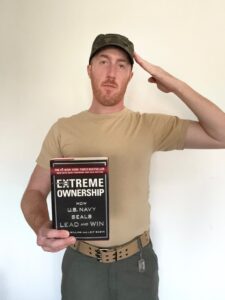
 For Jocko Willink and Leif Babin (former Navy SEALS), leadership starts with taking extreme ownership of oneself. “On any team, in any organization, all responsibility for success and failure rests with the leader,” they write, “the leader must own everything in his or her world.” There should never be blame placed on anyone else, they believe, especially subordinates. If a junior member of the team doesn’t understand something, the leader must assume responsibility for not communicating the plan to them effectively. When a mistake is made, the leader must take ownership of the team’s failure and develop strategies so that it doesn’t happen again.
There have been countless books on the topic of leadership written over the course of human history and the real challenge isn’t finding one, but finding the right one. This one is written by soldiers, and it has many gems to offer. Willink and Babin developed their philosophy of leadership on the dusty urban battlefields of war in Iraq and their methods are now the standard operating procedure for US Navy SEALS, some of the world’s most dedicated warriors. For these brave men, success or failure is a question of life or death, which is why their philosophy starts with ownership of oneself.
With extreme ownership as the overarching theme of the book, the authors then explore other tenets of their philosophy of leadership, each accompanied by a relevant war-story and subsequently a relevant business-story. One of their first is checking the ego because only humble leadership builds trust. Ego clouds and disrupts “the planning process, the ability to take good advice, and the ability to accept constructive criticism” and can even stifle someone’s sense of self-preservation. Another important idea is the ability to prioritize and execute, especially when time is short and people are stressed. In the book, Babin tells a story about his team of SEALS finding themselves trapped on an exposed rooftop in Ramadi (the city in Iraq where our authors spent a majority of their combat deployment) and having to figure out a way to safety before the enemy found them. He had to prioritize his team’s safety and execute an improvised plan of escape in a matter of minutes in order to save everyone’s life. Hopefully we will never find ourselves in such a life-or-death situation, but the message is clear: It is the leader’s job to prioritize the most important thing for the team to focus on and enlist everyone in its execution. A third tenet is decentralized command, which is the process by which a leader entrusts and empowers his or her junior leaders to make decisions and take ownership of those decisions. This simultaneously allows senior leaders to focus on the bigger picture and junior leaders to take extreme ownership of whatever job they have been assigned.
What if my boss is a weak leader? What if my boss makes me do things I think are wrong or ineffective? “Leadership must always present a united front to the troops,” our authors write, because a public display of discontent or disagreement within the chain of command undermines the authority of leaders at all levels. This can be catastrophic to the performance of any organization (and is especially important if you have a weak leader). Every leader is aware of their job to lead those below them in seniority, but Willink and Babin suggest an additional strategy: leading up the chain of command, not just down. Leaders must be able to approach their superiors with questions, concerns, and solutions to problems the same way their subordinates must be able to approach them. It’s a two-way street; the influence goes both ways.
Last year, I got a new job coaching soccer for a youth academy and have found myself in a new leadership position. Not only do I have kids to coach, but I have younger coaches who work beneath me, a manager I report to directly, and a boss who owns the company. Within our network, all of the tenets of Willink and Babin’s philosophy are present. My boss gives me the game plan for each week’s lesson, but then allows me to coach my players in what I deem to be the best way possible (decentralized command). My manager and I coordinate on the best way to organize our players by age and skill level (prioritize and execute). I check in with my younger coaches during practice and ask for their ideas about what is working and what we need to improve upon (checking my ego). When I have a practice or a game that isn’t going well, I try to assume extreme ownership of the failure and examine what I can do to fix it and not let it happen again in the future. Willink and Babin’s philosophy of leadership has been very helpful for me in my job as a soccer coach and I suspect it is useful in many hierarchical contexts like sports, business, government, military, and others.
I’ve only touched on a few of the main takeaways in my review, but the exploration of leadership continues in what Willink and Babin call “the dichotomy of leadership,” which is the idea that the best leaders must exhibit the correct leadership quality in the right circumstances. Sometimes they must make decisions, sometimes they must delegate decision-making to others. Sometimes they must go first, sometimes they must watch from the rear. Sometimes they must remain stoic in the face of hardship, sometimes they must show emotion when connecting with their teammates. The only constant is taking ownership. “Leadership is both art and science,” they write, “there are no exact answers or specific formulas to follow in every case. In any situation, there exists a great deal of gray area, neither black nor white. There may be an infinite number of options for potential solutions to any one leadership challenge.” Given that it is true that no leader has ever faced the same problems as any other, the best strategy is to develop guidelines for how to lead, a philosophy of leadership, which is exactly what our authors have done. With the right philosophy, a leader can tackle any challenge. Their philosophy starts with assuming extreme ownership of any and every situation because the individual who takes extreme ownership of their situation is one who is proactive about solving problems.