





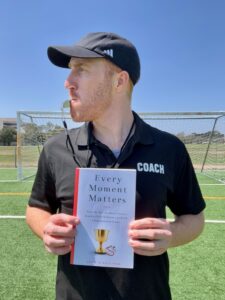
 Part one of this book is titled: Why do I coach? and it is a question all of us who decide to coach must answer for ourselves. I recently became a soccer coach and despite coaching four days a week for over a year, I still feel as though I’ve barely begun my journey. I picked up this book hoping to gain some knowledge about how to navigate the difficulties I have been encountering as a coach and am happy to report that I learned a lot.
“Great leaders and teams are outcome aware but purpose and process driven,” O’Sullivan writes, and I believe this to be true. As coaches, we have little control over who wins and who loses and must exert whatever influence on the game we might have from the sidelines. Our objective, then, should be to inspire our athletes to perform their best. As long as they are showing up for themselves and their teammates, are always trying to improve in practice, and are playing to the best of their ability in games, we are doing our job as a coach.
Part two of this book is titled: How do I coach? and the number one answer is to never stop learning. “Great coaches are innovators,” O’Sullivan says, “they never stop learning, they never stop honing their craft, and they are always looking both inside and outside their sport for information they can borrow and use with their own teams.” The beauty of coaching is that it isn’t just a science, it’s also an art, and while there are plenty of bad ways to coach, there is no ‘correct’ way to do it.
O’Sullivan doesn’t just deal in philosophy, he offers practical tips as well, like making training sessions as game-like as possible so that skills acquired in a practice environment transfer to the game. He’s a proponent of a practice technique called “interleaving,” which is when different yet related skills are mixed and matched in a variety of ways throughout a training session. Research shows that solving similar yet slightly different problems promotes long-term retention compared to massed (or blocked) practice. It works in the classroom as well as on the field.
As you might surmise, there is a lot more to coaching than running drills in practice and setting your starting line-up on game day. That practical part is important of course, and every coach worth their salt spends time planning training sessions and consulting their roster, but simply focusing on the tangibles won’t turn your team into a successful one. It’s the intangible aspects of coaching, like how to inspire our players to show up and play hard, that are tricky.
Part three is titled: How does it feel to be coached by me? and talks about the intangibles. “Culture comes first, and everything else follows,” O’Sullivan writes, “your DNA will promote improvement in the good times, keep you on the right path when the scoreboard may not be in your favor, and tell you when you have veered even if the scoreboard is in your favor.” O’Sullivan advocates for collectively creating team standards as opposed to the coach setting rules, because “when young athletes encounter rules, they constantly test them to see how far they can go before they are held accountable for breaking them. Standards, on the other hand, are something to be strived for and attained.” Having standards that everyone on your team buys into encourages your athletes to hold themselves accountable and can be a great way to build a positive culture.
One of the most important things a coach must do is establish trust with their players. It is paramount to creating a positive team culture. “Trust is the secret ingredient of great coaching and great teams,” he says, “it is the foundation of all great relationships, and great relationships are the basis of winning teams.” Every team must establish a triangle of trust between players, coaches, and parents, because without this triangle coaches cannot get the most out of their players, players cannot perform their best, and parents don’t feel comfortable releasing their children to the guidance of coaches.
These are just some of the tidbits I picked up from this book, but there are many. For example, do players feel emotionally safe enough to make mistakes and try new things in the quest for improvement? Are we praising effort, which we can control, as opposed to outcome, which we can’t? If our players are young, how are their parents talking to them in the car ride home after a tough game? And, one of the most important questions we always need to keep in mind, is are we having fun?
If you have any inclination to learn about the ins and outs of coaching from someone who has done a lot of it (O’Sullivan has coached every level from young children to college athletes for over twenty years) this book is a great place to start. It won’t just help you develop better athletes, it’ll help you nurture better people.