




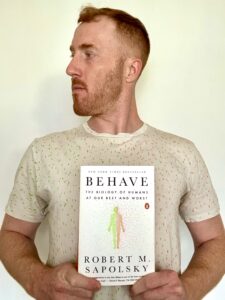
 Why do humans act the way we do? What determines our behavior and our thoughts about our behavior? Is there any philosophy or scientific study that can help us begin to unravel the mystery that is our words, actions, and thoughts? This book is a sweeping review of the neurobiology of humans and it provides some clues to the mystery of our behavior.
The first chapter is the shortest and starts with an action: We kill someone, or, perhaps guided by our better angels, we save someone’s life. Then, Sapolsky spends the rest of the book examining why we chose a particular action, starting with one second before our behavior occured and expanding out to minutes, hours, days, weeks, and years before. He covers biology, evolution, morality, empathy, nature vs. nurture, and much more. Sapolsky has compiled seemingly every scientific study done by a neurologist in the past century into one book and organized it in beautiful fashion.
A classic study is the story of Phineas Gage, a railroad worker from 1848 whose job was to blast rock (to make way for the train tracks) by using a long iron tamping rod to pack gunpowder into a drilled hole. One fateful day on a September afternoon, something went wrong, and the iron rod blasted out of the hole and straight through his head, entering under his left cheek and coming out the top of his skull. Amazingly, he didn’t lose consciousness for more than a few moments, took himself to the doctor, and survived. What’s most amazing, and the reason why his story is studied by neurobiologists, is that his personality drastically changed. Before the accident, friends and coworkers described him as responsible, hard-working, and even-tempered, whereas afterwards he became impulsive, profane, and unreliable. Gage’s story reveals that specific parts of the brain control specific functions, and that the left frontal lobes could be where personality and executive function live.
Another classic study is the Stanford Prison experiment, where 24 male students were randomly assigned to be either guards or prisoners in a pretend prison environment set up by their professor, psychologist Philip Zimbardo. Zimbardo was interested in how the social roles we inhabit and the environment we operate in affect behavior, and the results were monumental. Within days, the ‘guards’ began abusing the ‘prisoners’ who complementarily showed emotional distress. Some of them even had emotional breakdowns, and things became so intense that the study was stopped after only six days (it was planned to last fourteen). While the ethics of the study are questionable, what is still talked about in psychology classes today is how both the environment and the social relation of the people involved (those in positions of authority vs those who are not) impact behavior.
Sapolsky examines studies about maternal care and epigenetics, testosterone and oxytocin, population density and social pathology, delay of gratification, implicit associations, utilitarianism, adverse childhood experiences, and more. The point is, there are tons of studies all explored carefully in his writing, and each is included because it reports on a different aspect of human behavior. So, what are his the meta-conclusions?
First and foremost, there is no single cause of behavior. To understand behavior better, we must take into consideration our neural firing patterns, our hormones, our immediate environment, our larger social context, our childhood and prenatal environment, our parents, and our evolutionary history, just as a place to start.
Secondly, our actions are heavily dependent on the context of their occurrence. Authority, stress, anonymity, and group pressure are some examples of phenomena that can radically shift behavior depending on the context. For example, oxytocin doesn’t simply create feelings of love and bonding, it strengthens in-group bonding, which, in the right context, can also lead to increased feelings of out-group hostility.
Thirdly, adolescence is a critical window of development because it’s when our frontal cortex grows the most. Because it is the last past of the brain to mature, by definition the “frontal cortex is the brain region least constrained by genes and most sculpted by experience.” And what does it do? Its list of expertises includes “working memory, executive function (organizing knowledge strategically, and then initiating an action based on an executive decision), gratification postponement, long-term planning, regulation of emotions, and reining in impulsivity.” No behavior can truly be diagnosed without understanding the frontal cortex.
Fourthly, stress is a major player in our decisions and actions and has deleterious long-term effects. It changes brain architecture, impairs impulse control, increases aggression, and alters risk assessment, just to name a few. Combine stress with early development and adolescence and its effects can change the biology of the brain permanently. “Childhood adversity increases the odds of an adult having (a) depression, anxiety, and/or substance abuse; (b) impaired cognitive capabilities, particularly related to frontocortical function; (c) impaired impulse control and emotion regulation; (d) antisocial behavior, including violence; and (e) relationships that replicate the adversities of childhood (e.g., staying with an abusive partner). And despite that, some individuals endure miserable childhoods just fine.”
Fifthly, humans are capable of incredible acts of cruelty and also extraordinary acts of altruism. We are able to dehumanize others with frightening ease and we are also able to see others as ‘Us’ and not ‘Them’ if we can shift our lens of who we consider an ‘Us’. You might like the Yankees while I like the Red Sox, you might be South African while I’m American, but at the end of the day, we’re both human.
While these are some of the main themes, in a book this expansive, there are tons of fascinating nuggets of information throughout its pages. For example, judges have been shown to give out harsher punishments when they’re on an empty stomach, and are statistically more lenient after lunch. For another example, “the linking of visceral and moral disgust is bidirectional.” So, if we commit a morally dubious act, we are likely to feel dirty and will spend longer washing our hands. Likewise, if we are tired and covered with sweat and dirt after a long hard day at work, stealing a can of soda from the corner store is a much easier act to commit than if we are freshly showered and shaved.
In conclusion, the important thing to keep in mind is that all of these findings are broad trends in the data. Each and every individual is different and will behave differently in different situations based on a combination of what happened in their brain one second before they acted, what happened to their ancestors a generation ago, and what the context of the situation is. Humans are a one of a kind species, with a one of a kind brain, and despite thousands of years of self-contemplation and scientific study, our behavior is, well, complicated.
Leave a Reply