




I’m a writer and author with a passion for exploring ideas.
Since 2020, I’ve published monthly book reviews as a way to reflect on what I’ve read. I do my best to challenge my own thinking and remember the lessons worth keeping. Here you’ll find my books, my reviews, and my reflections on the ideas that have shaped my perspective along the way.
My Book
 |
Paradox PhilosophyAll things are in both harmony and tension with their opposites—we often choose certainty despite our doubts, fear when there is opportunity for hope, and ourselves when we might think of others—and we should always strive to find greater balance between them. We all want to live meaningful lives, hopefully lives of moral goodness, and philosophy is the study of this venture. Paradox Philosophy is a modern, Westernized version of Yin Yang theory that delivers wisdom towards living a more virtuous life. Available at: |
Book Reviews
- Man’s Search For Meaning by Viktor E. Frankl December 4, 2020
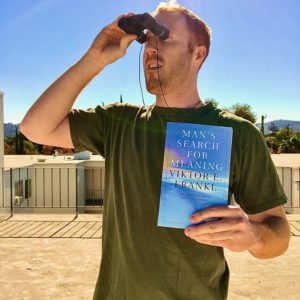 This is exactly the right book to read during the coronavirus pandemic of 2020. Viktor Frankl was a prisoner of multiple Nazi concentration camps and, although our conditions are not nearly as dire, most of us have felt like prisoners in our own homes for at least some period of time this year. With that correlation in mind, this book offers many great insights into why we should continually get out of bed in the morning. I myself have been out of a job and quarantined for over nine months. I have seen some friends descend into overwhelming anxiety and depression and have seen others take wonderful advantage of their new found time. “Even though conditions such as lack of sleep, insufficient food and various mental stresses may suggest that the inmates were bound to react in certain ways,” Frankl writes “in the final analysis it becomes clear that the sort of person the prisoner became was the result of an inner decision, and not the result of camp influences alone.” We become the person we tell ourselves we are.
This book is all about finding and choosing to actively pursue a life of meaning. Dr. Frankl is a psychiatrist and psychoanalyst who is widely credited with establishing the field of logotherapy (from the Greek word logos meaning “reason”) as a psychiatric technique that uses existential analysis to help patients resolve their emotional conflicts. According to logotherapy “we can discover this meaning in life in three different ways: (1) by creating a work or doing a deed; (2) by experiencing something or encountering someone; and (3) by the attitude we take toward unavoidable suffering.” This was how he survived the Holocaust, and how we can learn to find our own meaning in times of perceived meaninglessness.
When he was arrested in 1942, Frankl had a partially finished manuscript that he was forced to leave behind. On those days when he felt apathy creeping in, he reminded himself of his desire to someday finish the book, and this purpose towards the future motivated him to keep going. Also when he was arrested, so was his family and pregnant wife, and similarly on those days when he felt supreme despair, he thought of his loved ones and found purpose in continuing on with the hope of someday reuniting with them. “It is a peculiarity of man that he can only live by looking into the future” Frankl contends, and further writes of his time in the camps that “the prisoner who had lost faith in the future—his future—was doomed.” It seems true to me that without something promising to look forward to, despair at one’s current situation quickly sets in.
One of the messages in this book that resonated most with me was the sentiment that the meaning of life must come from inside each individual and be unique to them. There is no all encompassing meaning of life, but each of us has our own meaning that we are meant to discover and pursue on our own. We must all make choices about the people we want to be and the people we want to become. Having a sense of meaning and a true purpose in life is like having an existential North Star. As long as every choice, big or small, points in the direction of your North Star, you will never be lost in life.
Find your North Star my friends.
- On Liberty by John Stuart Mill November 23, 2020
 Liberty is something we in the western world take for granted these days, and it’s important to remember that humankind was not always so generously geared towards personal autonomy. Published in 1859, Mill was at the forefront of political science and philosophy thinkers when he proffered his ideas on the subject. “Over himself, over his own body and mind, the individual is sovereign,” he writes.
Once we move past this initial foray into the principles of liberty, Mill furthers his offered opinions. He warns us about the oppression of the ideals of the majority towards the minority. These ideas can be captivating, sometimes to the point of detriment. We can see it in society today, how so many of us find opposing ideas (especially political ones) truly intolerable. If we have progressed to a point in society where we accept other people’s religions and sexualities, why do we struggle so much to accept different ideological points of view? On this, Mill says that “There is no parity between the feeling of a person for his own opinion, and the feeling of another who is offended at his holding it; no more than between the desire of a thief to take a purse, and the desire of the right owner to keep it.” I find this sentiment to be alarmingly true, and may we ring all the bells in the land with its message.
The truth is that there is a necessity for opposition to ideas. That is how shaky ideas become strong or how weak ideas are proven anemic. There is tremendous danger in relegating popular ideas to the forefront of public opinion and vilifying opposition. The best ideas are the ones that have continually stood the test of time, repelling opposition not with crushing force, but with uplifting power. For example, ancient tribes used to sacrifice human lives to the Gods for the hope of a better harvest. As civilizations grew, they eventually decided life shouldn’t be ended so simply. Death then became a punishment for wrongdoing, and over the course of centuries slowly transitioned from barbaric to (relatively) humane. Eventually, as a more modern society emerged, we came to condemn the taking of human life with more frequency, until now it is a rarity. History shows us that the acceptable reasons for ending a human life has been a debate for the entirety of humanity. The reason we live in a world today where you don’t lose your life for stealing a sheep is because enough people, over time, spoke up and said it was a bad idea, preferring alternative punishments. This is but an example of how different opinions on a single subject are required to continually clash and debate as to what is most correct. Here we see the good idea (valuing human life) winning over the bad (seeing human life as insignificant) due to the trials of time and ideological combat.
By today’s standards, much of what Mill writes would be considered Libertarian ideology. Basically, get the government and any oppressive bodies of influence out of the individual’s life. The only exception is when an individual would bring harm to another. This is where the government would have an obligation to step in, ultimately in the pursuit of a safer society for all.
One of the areas that becomes grey is the relationship between parents and their children. Parents have a moral obligation to raise their children to the best of their ability, but what happens if a man has no desire to be a part of his child’s life. Can society demand that he participate against his will? What about a contrary case study with a parent who is raising a child to be an abomination. Does a ruling body have authority to step in and violate the liberty of the parent on behalf of the wellbeing of the child? The answers are tricky and each scenario must be evaluated case by case. Even still, decisions made cannot be assured with one hundred percent certainty and approval from all parties. Hopefully, over time and continual debate, humanity will continue to get better at solving this age-old dilemma.
This balance between societal prosperity and personal liberty is constantly teetering back and forth. It is the crux at where we live. Something I think important to remember, phrased quite eloquently by Mill, goes like this: “In the human mind, one-sidedness has always been the rule, and many-sidedness the exception.” Essentially, if we want to keep our balance as a society, it is important to hear and understand people’s differing ideas. Only with this mutual respect for each other’s ideological liberties can we continue to move forward collectively.
- The Dichotomy of Leadership by Jocko Willink and Leif Babin November 13, 2020
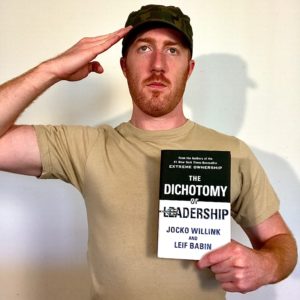 Leadership is inherently difficult. It requires tactical nuance, dedicated attention to your team members, and a never ending desire to improve. Countless books have been written on the subject and many more are destined to follow. What makes this one unique is that it was written by two men who learned leadership in the fire and chaos of war.
Although this book is called The Dichotomy of Leadership, it is really about the dichotomies of life. There is a balance to everything in life, and through the lens of leadership, we can study some important aspects of it. Like when to be aggressive and when to be cautious, or when to be resolute and when to be flexible. The dichotomies are complex, but the lesson is simple. All leadership qualities exist on a scale and it is the leader’s job to determine where on the scale he should place his response to any given situation. Every decision made is unique to its context and none should be passed over lightly. The details are always important, especially in war, where lives are literally at risk. What better way to learn leadership (or anything, really) then with the highest of stakes?
An important point not expressly stated in the book, but intrinsically alluded to, is that there are no steadfast rules. This may come as a surprise seeing as this book was written by military men, and the military is known for its Standard Operating Procedures, but the knowledge between the written lines is clear. In nearly any and every capacity, in both leadership and not, rules should be interpreted more as guidelines. What is imperative, is the knowledge as to why the rule is in place. Only then can you understand when it is appropriate, even necessary, to break it. For example, the military has a specific method for entering and ‘clearing’ a house of enemies. Why is this important? So that nobody gets killed. However, if the leader goes right along with the train of men, then he may find himself stuck in one room while the action is suddenly taking place in another. How is he going to make a decision to help his team if he isn’t present? In this situation, the leader must break the rules of formation and go help his squad. His ability to improvise in the moment is critical. For another example, take a company that utilizes a large force of sales callers. They are all expected to memorize a script in order to funnel their prospective buyers towards a purchase. Why is this important? So the company makes sales and earns a profit (and also so the individual sales callers earn their commissions.) But what if the buyer on the line makes a joke and the conversation takes an unexpected turn? The rules would say that the representative should pull the reins back to the script. Anyone who actually does the job will tell you the connection to the buyer is the most important thing, and would perhaps respond with a joke of their own and allow the conversation to meander off script for a while. Again, the ability to improvise in the moment in imperative. The lesson is that no two scenarios in life are ever the same, regardless of whether you’re on the battlefield, in the office, or anywhere else. It makes sense then, that every situation should be handled differently. It is therefore important to learn the rules, follow them, and yet also know when to deviate in order to achieve the desired success. This is the true dichotomy of leadership, and, in essence, the most important dichotomy of life.
Another significant take away from this book was the importance of humility in a leader. In his chapter on humility, Leif writes: “Leaders must be humble enough to listen to new ideas, willing to learn strategic insights, and open to implementing new and better tactics and strategies. But a leader must also be ready to stand firm when there are clearly unintended consequences that negatively impact the mission and risk harm to the team.” Another leader I am quite fond of, famous for his humility, comes to mind. That man is George Washington, one of the most historically respected leaders in history. Ego is indeed the enemy (just ask Ryan Holiday) and everyone, leader or not, needs to keep theirs in check. Many of the ‘rules’ in this book are similar in that they are applicable to all people, not necessarily just those in leadership positions. Although being humble makes for a good leader, it also makes for a good individual. Any person who can take criticism constructively and work to better themselves is a person of strong moral character.
The only part of this book that frustrated me was their purposeful redactions. Due to their desire to keep specific companies anonymous, a lot of details are left out and banal words like “company” and “procedure” are used to nauseating boredom. I appreciate wanting to respect privacy, but I think in this instance it came at the cost of being interesting. The details are what make a story pop! Of course, these guys aren’t writing a story – they are relaying information. And for that purpose, this book is exquisite.
- The Righteous Mind by Jonathan Haidt October 27, 2020
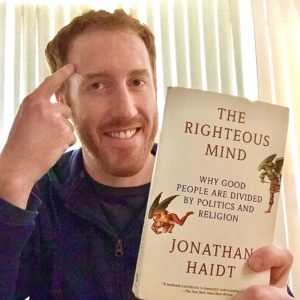 All societies are made up of individuals and the groups they form amongst themselves. These groups are modeled around sports, religions, politics, communities, and any number of things. Early humans learned to work together for mutual protection and the advancement of everybody, and these ancient tribal societies became more and more group oriented as populations increased over time. The rise of the individualistic minded society only came about at the hands of the Enlightenment in the 17th and 18th centuries. It was a slow and multi-national movement that mostly occurred in Western Europe, and it laid the blueprint for our current global cultural differences.
Today, some societies still follow the sociocentric model (the group, tribe, herd, congregation, and team first,) and place the needs of the individual second. Conversely, individualistic societies (like the United States and modern western cultures) have more recently put personal liberties first and foremost, and the needs of the greater group have been pushed towards the back burner. Sociocentric societies exist today in certain parts of the world, like the Middle East, and also in forms of governing like fascism, communism, and socialism. Individualistic societies are most often exemplified by capitalism, or most countries in the western world. It’s kind of like the old world versus new world. And yes, the versus is exactly the source of tension. Wouldn’t life be better if it was the old world and the new world?
Middle Eastern cultures have largely not gone through any “enlightenment” period. The Middle East is still a place with deeply ingrained religious practices in addition to rigid familial and cultural hierarchies. These cultural institutions are in place to keep the clan together and cohesive, and to keep society functioning. In the US, as a counter example, we have more secularism than ever before, an erosion of ‘traditional’ family structure, and more personal freedoms than any society before in existence. Science has convinced a large swath of western civilizations of the non-existence of God. Not to mention, we love our right to say fuck the government and not be thrown in jail for it. This is not a reality everywhere in the world.
Now, this is not to say that group cohesion is nowhere to be found in the western world. Obviously there is plenty of it to go around (and plenty of individualism in other cultures as well.) Where the biggest dichotomies lie are in the moral reflections of these foundations. In the western world, questions of morality are favored towards the individual. Take for example a man who goes to the supermarket and buys all the chicken. We might find it detestable that he could be so selfish, but we would conclude that it was his right to do so and we would all eat beef, pork, or microwavable pizza that evening instead. People living in the Middle East would see this as morally wrong and would never dream of doing such a thing. People living in communist or socialist countries would never even be given the chance.
Morals themselves are also tricky things. In his book, Haidt writes about his clinical studies proving that “people made moral judgements quickly and emotionally” and that “moral reasoning was mostly just a post hoc search for reasons to justify the judgements people had already made.” This, in essence, is confirmation bias in action. We all do this, and it would be well on us to understand this aspect of humanity and try our best to recognize it when it happens. A clear example is a controversial foul called in sports when both teams are convinced the other is at fault. Think about the chorus of boos when a referee makes a tough but correct call against the home team. The fans are not reacting to what is correct or fair, they are reacting to harm against their team. If you sat them down individually, they would certainly agree with the refs decision, but when you put them all together and raise them out of individuality to the mental realm of group-think, reason goes out the window in preference to group cohesion.
In his book, Haidt posits that human beings evolved on two tiers—individually and in groups—and that is how we have come to live today as mostly selfish beings (concerned with personal liberty) with the ability to give it all up for the wellbeing of the group (much like bees do for their hive.) If you’ve ever felt lost in a sea of fans at a concert or sporting event, or felt connected to something bigger than yourself when at church, then you recognize what it feels like to be pulled up from your individual thoughts to the collective conscious of the group. It’s often trance-like, with time elapsing faster than it usually seems to do. The same way that we shout and chant along to our favorite football team, we shout and chant along with our preferred political team.
If you apply confirmation bias to political debates, you can immediately see how problems manifest. People will believe pretty far-fetched stuff if it’s in the best interest of their team. (To take it one step father, every time you ‘successfully’ make a moral defense of a controversial contention, say on whether or not abortion should be legal, your brain produces a hit of dopamine. Do this often enough and defending your beliefs, whether right or wrong, becomes literally addictive.) It’s no wonder the political divide in this country is so huge! Haidt sheds some light on finding success in arguments when he writes: “If you really want to change someone’s mind on a moral or political matter, you’ll need to see things from that person’s angle as well as your own. And if you do truly see it the other person’s way—deeply and intuitively—you might even find your own mind opening in response. Empathy is an antidote to righteousness, although it’s very difficult to empathize across a moral divide.”
Nailing down the differences between Republicans and Democrats can be done a thousand and one different ways and here Haidt offers up his own diagnosis. He believes that the two parties have different foundations for what they consider to be morally right and wrong. An example he uses in the book is the spanking of children. Democrats view spanking as cruel to the child (this I can attest to—I have left-wing parents and they openly preferred ‘time outs’ to physical spanking). Republicans view spanking as part of the proper enforcement of the rules of authority, in addition to instilling respect for elders into kids. Both are moral judgements. More broadly on the left, liberals tend to care more about marginalized groups of people and they strive harder for equality at any cost. They are determined to grant everybody equal rights and equal opportunity. Again, on the right, conservatives are concerned with fairness (you get out what you put in) in addition to favoring what is best for their group. This is why conservatives are often more religious people, and are also more likely to use terms like Sir and Ma’am when referring to peers and elders. Respecting your elders shows respect for the social hierarchy and hierarchies are important for keeping groups together. If nobody is in charge, you have chaos. Conservatives are also much more loyal people, and see disloyalty to the group as morally wrong.
As an example of their different morals at work, the same way that democrats feel it is morally wrong that conservatives don’t want universal health care, conservatives think it is morally wrong when people trample the American flag (or take a knee before a football game.) Democrats think: “if you don’t want universal healthcare, you don’t care about the people of this country.” Republicans think “if you destroy the flag, you are disloyal to our country (and disloyal to the group.)” In reality, both can and should coexist. We need to care about everybody in the nation and we need all of us in it to stay loyal to the nation itself.
One of the conclusions that Haidt makes in his book is that modern liberals care too much about helping different subgroups of people and are doing so at the expense of the country as a whole. He writes: “the urge to help the inner-city poor led to welfare programs in the 1960s that reduced the value of marriage, increased out-of-wedlock births, and weakened African American families.” He goes on further: “the urge to empower students by giving them the right to sue their teachers and schools in the 1970s has eroded authority and moral capital in schools, creating disorderly environments that harm the poor above all.” These are just two examples, but there are plenty more. Although their hearts are in the right place, these attempts to help the disenfranchised continually lead to more destruction then growth. The more this happens, the more conservatives pull towards their traditional values and institutions and advocate for things like the sanctity of marriage and loyalty to your family. Haidt hypothesizes, and I agree, that the more the left tries to improve the country for one group of people (who do need the help) the more they destroy the country as a whole.
Middle Eastern societies and cultures have existed for far longer than the United States. Similar to western conservatives, they embrace religion, respect authority, and are loyal to their familial, community, and national groups. These values are clearly important to the longevity of society. The modern liberal movement wants to go against this grain, actively seeing authority as oppression and religion as nonsense. I fear for where we are headed and hope that we can all reconcile our differences sooner rather than later.
This book was excellent in helping me begin to understand people who come from different cultural backgrounds than myself. We all develop different ideas of what is morally right and wrong and it is up to us to understand these moral foundations as they exist both in ourselves and in others. Our herd mentality often blinds us to the experiences of other groups which only fosters hate and division. To not constantly yearn for a greater understanding of those who are different from ourselves is a laziness we can ill afford.
- Where People Fly and Water Runs Uphill by Jeremy Taylor October 15, 2020
 Jeremy Taylor spent his whole life analyzing dreams and it was inspiring to read his stories about helping people overcome their internal struggles. Dreams are often our subconscious mind telling us things we don’t want to hear. Like the young man masking his aversion to his religious promises or the woman who realizes her dreams are covering up a childhood molestation. When people repress these struggles, and refuse to acknowledge them, they can manifest in their slumber. Especially recurring dreams, which can often be nightmarish.
By the time I had finished the third chapter, I had the first dream that I’ve remembered in a long time. In his book, he suggests that simply deciding to remember one’s dreams will help with recollection, and that is exactly what happened to me. I had a dream where I was trying to get into a fortress. In the dream it was a house, but I recognized that it felt impenetrable. I was then following a cat that seemed to be leading me on a path to get inside, when at the very last minute the cat slipped into a doorway that was immediately shut off to me.
My interpretation is thus: The “impenetrable fortress” is representative of a loving romantic relationship. My subconscious is telling me that I want one yet it is something I feel like I cant quite attain. I’m trying to get into one by the means of chasing pussy (aka getting laid is my main motivator) which always seems to slip away at the last moment. Naturally I have spent this past week wondering if I should ditch the casual lifestyle for a monogamous relationship.
It’s funny how sometimes a book seems to fall into your hands right when you need it most. I wonder, however, if instead of the right “time” for a book to come across your path, if perhaps it is the right book that makes the magic. I think this is that kind of book. No matter when I was going to read it, it would have impacted me because I inevitably would have had a dream that spoke to me. And sure enough I did.
I was amazed at all the scientific and industrial insights that came from dreams. Most importantly was the idea for the modern sewing machine. With the inventions of the spinning jenny and the power loom, the sewing machine was the last bridge for the industrial revolution to cross. The idea for putting the thread hole in the tip of a sewing needle came to Elias Howe in a dream, and the sewing machine was born. It completed the economic structure of the retail clothing industry we know today.
Although not the aim of this book, the final chapter on zen meditation left with me a really golden nugget on enlightenment: “Enlightenment is habitual intuition.”