




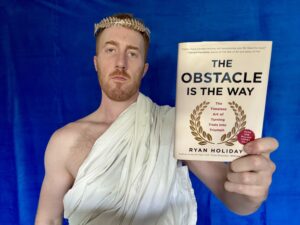
 Everybody’s got problems. We all wish they would go away or be solved, but that isn’t how life works, no matter how many times we tell ourselves “if I could just solve this problem, or just get past this difficulty, then I can get on with my life.” Inevitably, as soon as we solve our current problem, life presents another. The solution, then, is not to view problems as obstacles, bur rather to change our frame of mind and view them as possibilities for growth. Changing the way we think about the obstacles we encounter in life is the theme of this book. It starts with stoicism.
Stoicism has been a known philosophy for thousands of years. First taught by Zeno of Citium in Athens around 300 BC, it has ebbed and waned in popularity over the centuries. During the height of the Roman Empire, it was championed by Seneca, Epictetus, and the Emperor himself, Marcus Aurelius. It was lost for a while, as religion swept throughout the Eurasian continent, but was revived again during the Renaissance when Justus Lipsius and Michel de Montaigne brought stoic ideals to the public through their writing. Today, Ryan Holiday has brought stoicism’s tenets to our society in his own words, and this book is some of his best work.
The essence of stoicism is the idea that while we are not in control of the events of life, we are in control of how we respond to them. We cannot control whether or not it will rain today, but we can control what we may do in response to the rain and how it might make us feel. This is the same as any problem, setback, or obstacle we encounter: we can by stymied by our misfortunes or we can learn from them and use them to grow.
In 1914, a massive fire erupted in Thomas Edison’s factory and burned up years of his work in a matter of hours. Instead of despairing, Edison said “Thank goodness all of our mistakes were burned up, now we can start fresh!” He used the disaster as an opportunity to reset, refocus, and rebuild. We too can follow this example; Let’s say we lose our job. While this might initially feel like a huge obstacle because we are losing our source of income, we might change our thinking and recognize it as an opportunity to find a new job that pays more or that we like better. Losing our job might have been unavoidable, but determining what we do as a result, the story we tell ourselves about why, and ultimately how we feel about it is up to us. This leads me to one of my favorite parables: The story of the Chinese farmer.
Once upon a time, in a village in China, there was a wise old farmer. One day, his horse ran away, and all the neighbors came to his house to offer their condolences saying “Oh no, how terrible, your horse has ran away!” The farmer simply replied “Maybe, we’ll see.” The next day, the horse returned, bringing with it three wild horses, and the neighbors came back and said “Wow, how wonderful, you have three new horses!” Again, the farmer simply replied “Maybe, we’ll see.” The next day, the farmer’s son was trying to tame one of the wild horses and was thrown off and broke his leg. The neighbors came with their condolences saying “How awful, how sad that your son has broken his leg,” to which the farmer again replied “Maybe, we’ll see.” A week later the army came to the village conscripting young men for war, but because of his broken leg, the farmer’s son was not taken. The neighbors celebrated, exclaiming “How lucky you are that your son does not have to go to war!” Once again, the farmer only replied by saying “Maybe, we’ll see.” The moral of the story is that we never know what is going to happen next in life, so celebrating or lamenting a recent event is all but futile. What we can control is how we respond to the various events of life and what stories we tell ourselves about their meaning.
What makes this book a success is Holiday’s ability to translate his concepts into bite size pieces of actionable advice. It’s not just theoretical, but practical. Holiday breaks it down into three parts: Perception, Action, and Will.
In the first part, on perception, Holiday asks us to be objective about how we perceive the world. He encourages us to let go of our ego and our desire to see things as we wish they were and embrace the realities of what is. He urges us to control our emotions and judgments, lest they get the better of us. In the second part, on action, Holiday asks us to take deliberate, bold, and persistent action. He suggests, once again, that we focus on what we can control, and not expend energy worrying about things that are beyond our capabilities. In the third part, on will, Holiday suggests that we prepare ourselves for adversity, loss, pain, and the potential for none of our efforts to produce our desired results. He inspires us to cultivate resilience and inner fortitude, for even if our efforts at solving a problem are successful, there is inevitably another one coming soon, most likely before we are ready for it.
I have read this book several times throughout my life and I like to keep it close at hand for whenever I need a little philosophical inspiration. The chapters are bite-sized, each taking a couple of minutes to read, and are great for reflecting on and considering how each idea may or may not resonate in our own life. It’s jam packed with stories about such figures as Ulysses Grant, Thomas Edison, Margaret Thatcher, Amelia Earhart, Samuel Zemmurray, Erwin Rommel, Richard Wright, Laura Ingalls Wilder, Barack Obama, Nassim Taleb, and many, many more. Holiday writes in such a way that we, the reader, feel equal to these great men and women in our endeavors, for we are all just human beings solving problems to the best of our ability. It is well written, inspirational, actionable, and for everybody. If you read this book, you too are a philosopher.
Leave a Reply