




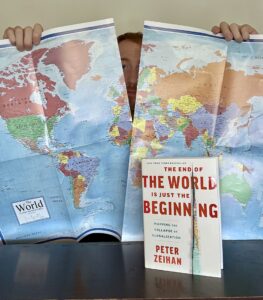
 In the early days of human development, economics was regional: people could only trade goods and services within a reasonable proximity of where they lived. Populations and trade networks grew slowly over time as Empires (like the Roman’s) connected the ancient world via networks of roads. Inevitably, innovations in boating led sea-trade to expand the economic scope even farther as humanity progressed into the 17th, 18th, and 19th centuries and the world began to industrialize. As trade routes expanded across the globe, so did global interconnectedness, and “while the Industrial Revolution made it much cheaper to ship products from A to B, it took the Americans’ global Order to make transport much safer.” Since the close of the Second World War, the American military has transformed the seas from contested waters into safe, functional waterways. The premise of this book is what happens next: What happens when the Americans recede from their assumed role as the global shipping peace-keepers?
In short, everything will be affected, from transport to finance to energy to industrial materials to manufacturing to agriculture. Whereas the past eighty years have seen a remarkable number of countries industrialize, urbanize, and participate in globalization, Zeihan predicts that these trends will all reverse as globalization contracts. Deglobalization will lead to deurbanization which will in turn lead to deindustrialization. What will the world come to look like in the coming decades if this prediction proves to be true?
Things are going to look and feel different because they will in fact be drastically different from the world we have come to recognize today. For example, most oil and natural gas comes from three places on the planet: The Middle East, Russia, and North America. If shipping routes aren’t safe, what might happen when countries in Africa or Southeast Asia can no longer meet their energy import needs? In short, the lights will go out and the engines will stop. “If people cannot source globally traded energy products like natural gas or diesel, they will have a choice between not having heat for cooking or staying warm…or burning wood. The scale of the devastation—in terms of carbon emissions, land cover, biodiversity, smog, water quality, and safety—caused by half the world’s population reverting to wood burning is difficult to wrap the mind around.” It would certainly be a regression.
One of the scariest predictions in this book is Zeihan’s prediction for global agriculture. With safe global shipping routes, third-world countries have spent the past decades importing their food and growing their populations. What happens if they suddenly cannot import enough food? In short, famine. First world countries will also be affected, although probably not to the same extent. Without the ability to import the precious metals that go into manufacturing batteries and computer chips, we can say goodbye to electric vehicles and smartphones. The U.S. auto maker Ford, for example, taps “more than sixty countries and 1,300 direct suppliers that together have more than 4,400 manufacturing sites” just to build a car. We can all say goodbye to that, too.
A large piece of this global puzzle is also due to the aging populations of the industrialized world. The post World War Two generation is the largest generation of people the world has ever seen, a generation that is quickly reaching retirement age and requiring more state-sponsors services. This wouldn’t pose much of a threat if there were enough young people to replace them in the job market and continue generating taxable income. But there aren’t, and this is a trend that many countries around the world are experiencing including the United States, Japan, China, South Korea, Australia, Germany, France, England, and more. This places tremendous pressure on global finances as every major developing country has transitioned from a commodity-backed currency to a fiat one. To keep it simple, this basically means that central banks can print as much money as they need or want in order to pay for the government’s services to the people. This mass printing of money has led pretty much everyone into incredible debt, devaluing currencies across the board. This, also, does not bode well for the future.
So, what are Zeihan’s predictions for how things will shake out? “The defining characteristic of the new era is that we will no longer all be on the same side,” he writes and goes on to imagine a world broken up into factions. The Europeans will be on their own, as will the countries and islands of the southeastern pacific, as will Africa, the Middle East, and the Americas. Keeping this in mind, he speculates that America will probably be the best place in the world to be for a few reasons. Firstly, the US is the number one producer of oil and natural gas in the world, so our energy supply is safe. Secondly, we have good relationships with the Canadians and Mexicans, and are isolated from the rest of the world by massive oceans on each side. Thirdly, we still have a lot of space in the middle of the country for people, farms, and factories to occupy. The US will still experience hardship, but not nearly to the same extent as other countries with less advantageous geographies, less reliable currencies, and less stable political institutions.
The past eighty years of globalization have come to feel like normal, but the lesson illuminated in this book is that it is not. It has simply been a transitory period of time, much like all periods of time, and it is subject to change in drastic ways. The peace, prosperity, and “reasonable expectation of more” is what first changed the old economies of pre-global sea shipping routes. We have now reached another turning point (or breaking point) and if there is anything we can all expect from the future, it is not more; it is less.
Leave a Reply