




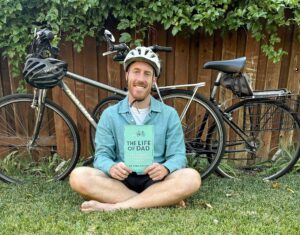
 Traditionally, dads are the hunters, the breadwinners, and the ones who initiate rough and tumble play. These are all important aspects of raising little ones, and they will continue to be, yet despite many of us living in the twenty-first century, many dads still feel relegated to the sidelines in preference for mom. While interviewing dads (of younger children) for her book, Machin found that many shared stories of exclusion. When the baby is on the way, dads are frequently asked to “wait outside while mums are examined,” are ignored in favor of mom when nurses have questions regarding wishes for the birth or aftercare, and are “left to let their worst imaginings run riot when their partner is whisked off for an emergency procedure.” Sure, mom is the one physically carrying the baby, but this exclusive focus on mom can be to the detriment of dad’s well-being and have led many men to report being made to feel like an imposter during the birth of their own child.
Machin’s work focuses on dads and specifically because I don’t have one, I was drawn to her research. The evidence she found is that dads are instrumental in the child-rearing process, even reporting on a number of recent studies that showed “the health outcomes for mum and baby, and the continuing health of the new family, are improved by fathers being involved in all aspects of antenatal care and birth.” When dads are involved, everybody wins. She also reports that “regardless of the socio-economic background of the mother and the general health of the baby, babies whose fathers were not named on their birth certificate were 2.5 times more likely to die in their first year of life.” This is even more evidence of the importance of dads.
Yet, this research doesn’t coincide with my own life experiences, and I wonder if perhaps the real difference between healthy and successful children and those that struggle is the difference between having one parent in the household instead of two sharing the load.
I was raised in a family with two moms and from personal experience I can assure you that even without a father figure in the house, all the chores still got done, the bread was still won, and admittedly the play was probably a little less rough and tumble than it might have been, but I still participated in sports and roughhoused with my friends. Humans have an amazing ability to adapt, and my moms were cognizant of the necessary element of raising children and maintaining a household and were each instrumental in both of those endeavors. In her book, Machin writes that in single parent households, the mom or dad will often take on the role of both parents: making the money while also doing the cooking and the cleaning. In my household growing up there were never any strict guidelines for who did what, both of my moms assumed the role of homework-overseer, dinner-cooker, and money-earner depending on the day.
There are, of course, some distinct differences in the way dads raise their children compared to moms, and Machin lays them out in her book. For example, she writes that while a dad has “some influence on his child’s actual academic attainment, his real power sat with the influence he had on his child’s attitude to learning.” She found that “dads who were involved with their children—who fostered good behavior, strong psychological health and a healthy attitude to life and school—taught their kids to have a good learning attitude, allowing them to reap all the benefits they could from their schooling.” This is an interesting phenomenon to evaluate in the home, basically asserting that moms make sure the homework gets done whereas dads make sure the kids know why they’re doing it and even have fun while they do. As anyone with kids will tell you, having fun is the secret to getting them to do any activity, even traditionally non-fun ones like homework. Again, in my own experience, my moms both played both roles, making sure I did my homework and also that I knew why it was important to do so.
In summation, our author argues that dads shouldn’t be shunned from the parenting spotlight like they so often are and should instead be celebrated for the contributions they make to the family. Having dads involved in the child-raising process undoubtedly makes for healthy and well-adjusted children and we as members of modern western societies should recognize this. Countries like South Korea, Japan, Germany, Norway, and Sweden have government mandated paternity leave for new dads, but that list is not nearly long enough. Many countries and companies offer no paternal leave at all.
The true take-away from this book, and one that I can personally attest to, is that the gender of the parent is less important than their emotional availability. Machin’s research supports this finding as well. “Regardless of whether the primary carer was a mum or a dad,” she writes, “the most basic of parenting behaviors—touch, simple soothing speech and gaze—underpinned a child’s ability to regulate straightforward emotions such as joy. Further, the extent to which parent and child were in bio-behavioral synchrony during infancy—that’s behaviors, physiological measures and bonding hormones all in synchrony—predicted how well a child could handle their more complex emotions, such as frustration and anger, and parents who were warm and positive but used suitable levels of control and employed boundary-setting—those are the social rules being enforced—had children who were well socialized within the pre-school setting.” Obviously, this can be a parent of either gender.
So, while this book is expressly pro-dad, it is perhaps better described as pro-team-parenting. Whether you’re a family of two moms, two dads, or a mom and a dad, both of you should be involved with raising the children if you want them to be healthy and well-adjusted adults. The real difficulty lies with single parents. With this in mind, it is true that in heterosexual couples dads do often take a backseat to moms, especially in healthcare settings. Dads can get postnatal depression just like moms can, and healthcare professionals, in addition to teachers, policymakers, and everyone else, all need to respect their involvement and input. Dads, just like moms, should be included and celebrated for their contribution to raising little ones.