




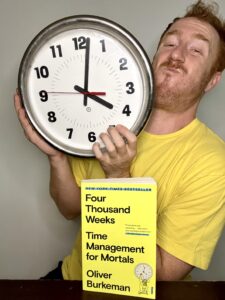
 The average human lifespan is about four thousand weeks. That’s all we get, if we’re lucky. So, what do we do with such a limited amount of time here on Earth? In an era defined by productivity, the answer to this question has never been more important.
Is life short or is life long? My ex-girlfriend and I always used to debate this question; she said short, I said long, but we both agreed that the answer depended on what we were comparing it to. If I’m comparing my lifespan to a fruit fly, it’s long, but if I’m comparing it to the age of the earth, it’s desperately short. Of course, the purpose of the debate wasn’t to determine who was correct because the answer is subjective, the purpose was to have a philosophical discussion about how to best spend our time.
She believed life was short, and placed on emphasis on living in the moment and bringing as much joy as she could to the people around her each and every day. I, on the other hand, think often about how the future of my life might play out and am constantly weighing how the decisions I make today will impact my life later on. When she wakes up in the morning, she thinks about what the day has in store for her. When I wake up, I think about what I can do to alter my tomorrow. I can’t speak for her inner voice, but mine often tells me I’m lagging behind my contemporaries and the obvious solution is to work longer and harder towards my goals.
What Burkeman touches on in his book is a message I need to hear: No matter how much I manage to get done, there will always be more to do. Efficiency is a trap! The tips and tricks for becoming a more productive person (organizing to-do lists, optimizing a morning routine, prepping and cooking meals for the whole week on Sunday night, etc.) will never leave us with more time because the faster and more efficient we become, the more life will send us things that demand on our time. “Facebook, for example, is an extremely efficient way to stay informed about events you might like to attend. But it’s also a guaranteed way to hear about more events you’d like to attend than anyone possibly could attend,” Burkeman writes. We tell ourselves that if we could just reply to the rest of our emails and empty out our inbox we will have time to attend to the things we really want to do, but the truth is “if it weren’t for email, we wouldn’t be receiving all those messages in the first place. The technologies we use to try to ‘get on top of everything’ always fail us, in the end, because they increase the size of the ‘everything’ of which we’re trying to get on top.”
One of Burkeman’s solutions, then, is to reevaluate our relationship with time. Time is not a resource that we can ‘use’ or ‘spend,’ he argues, and takes a page out of the German philosopher Martin Heidegger’s book when he suggests time is not something we have at all, but instead is something we are. The reason we cannot ‘spend’ our time on one thing or another is because we are always spending it every minute of every day no matter what. Whether we choose to go for a walk or to sit on the porch and watch the sky, time is passing. After all, when someone asks our age we don’t respond by saying “I’ve used 35 years so far,” we say “I am 35-years-old.”
Another solution our author offers to optimize our attention is to determine what things we are not going to do. This, in a way, is really what focusing is all about. It is the stripping away of any and all extraneous stimulus and giving our attention to the few select areas that we deem most important. We must ask ourselves, is it really that valuable to answer every single email if it means we might not get to the project we promised ourselves we would do? What if we leave the emails and instead focus on the things we deem most important?
If Burkeman had been present with my ex and I when we used to debate the length of life, he would have taken her side and implored me to view it as short. We’ll never finish our to-do lists, he would have said, and we should accept our finitude. “At the end of your life, looking back, whatever compelled your attention from moment to moment is simply what your life will have been,” he writes, “so when you pay attention to something you don’t especially value, it’s not an exaggeration to say that you’re paying with your life.” The lesson is simple: instead of trying to be productive in every area of our lives, we should carefully pick and choose the things we give our attention to. After all, we’re only here for four thousand weeks.
Leave a Reply